<?xml version="1.0" encoding="UTF-8"?>
<feed xmlns="http://www.w3.org/2005/Atom">
    <title>runninglondon</title>
    <link rel="alternate" type="text/html" href="http://maskit.net/rundembear/runninglondon/" />
    <link rel="self" type="application/atom+xml" href="http://maskit.net/rundembear/runninglondon/atom.xml" />
    <id>tag:maskit.net,2019-09-26:/rundembear/runninglondon//2</id>
    <updated>2017-09-11T13:33:45Z</updated>
    <subtitle>The running adventures of rundembear (Daniel Maskit). I run London with Run Dem Crew.</subtitle>
    <generator uri="http://www.sixapart.com/movabletype/">Movable Type 5.2.13</generator>

<entry>
    <title>Training With a GPS Watch Part 2</title>
    <link rel="alternate" type="text/html" href="http://maskit.net/rundembear/runninglondon/2017/09/training-with-a-gps-watch-part-2.html" />
    <id>tag:maskit.net,2017:/rundembear/runninglondon//2.35</id>

    <published>2017-09-08T12:04:35Z</published>
    <updated>2017-09-11T13:33:45Z</updated>

    <summary>In Part 1 of this piece I discussed how I use my GPS watch during workouts. In Part 2 I will discuss how I use the data gathered by the watch to analyze race performance. I will look at the...</summary>
    <author>
        <name>Daniel Maskit</name>
        
    </author>
    
    
    <content type="html" xml:lang="en-us" xml:base="http://maskit.net/rundembear/runninglondon/">
        <![CDATA[<p>In Part 1 of this piece I discussed how I use my GPS watch during workouts. In Part 2 I will discuss how I use the data gathered by the watch to analyze race performance. I will look at the difference between a specific training run and a race shortly thereafter to answer, at least in part, the question "what went wrong in this race?" I will also look at a different race and show how the data helps answer the question "How much did that minor injury affect my performance?" In doing these analyses I will explain a bit about what all this data means, and hopefully provide enough context to help others interpret their own results. </p>
<p>As with Part 1, this piece will be rather long and fairly technical.</p>
<h1><strong>What Went Wrong</strong></h1>
<p><span style="font-size: 16px;">In all honesty I probably don't come out of this particular story looking well. In a nutshell, I allowed myself to believe in unicorns only to have them desert me when I needed them most. With that out of the way you need not spend any time while reading this section wondering "does he know how bad this makes him look?" I do.</span></p>
<p><span style="font-size: 16px;">That said, let us go back a couple of years to a time when I first experienced "super-compensation." This is the phenomenon of your body responding to a reduction in training intensity by briefly attaining a much higher level of capability. In a perfect world this would be perfectly timed to happen on race day, although I don't know how one brings about that result (and my coach has been mysterious and elusive when questioned about this ). One morning I set out on a run. I expected this run to be about 8-10 miles as it was a 75-minute run. The goal for the run was to run evenly and to keep my heart rate in the upper portion of my heart rate zone 2. I started out running hard to get my heart rate up, figuring that I would be able to find the correct cruising effort once the heart rate was elevated. The first mile of the route I had chosen was uphill, which I knew would help with elevating the heart rate. I also knew that once I was past one traffic signal after the first 100 meters I would be able to do the whole run non-stop. As I ran uphill I felt like I was working somewhat hard, but in control. I quickly reached a landmark which I know to be about a kilometer from home. My watch beeped and told me that I had run that first km in 4:00. "What!?!" I thought. This is a pace which I expected to need to be working much harder to achieve. My heart rate was quite high, but it does sometimes spike at the beginning of a run so I wasn't too concerned about that. I maintained roughly the same effort for the second km. 3:59. Definitely something going on here. By this time my heart had settled into the desired range  and I was focusing on running smoothly. It felt almost effortless to maintain this heart rate. Actually, the problem, if any, was that my heart rate kept creeping into zone 3 and I needed to back off a little bit to keep it in zone 2. The kilometers flowed by. 3:52. 3:47. 3:46! Still running comfortably. The fact of casually running a sub-20:00 5K still astounds me even two years later. I do slow a bit through the middle of the run, but managed to finish back at home having run 18.75 kilometers in 75 minutes. An average of 4:00/km, and on pace for about an 85 minute half marathon, more than 10 minutes faster than my PB. I was gobsmacked. Then I thought that I had better go find a race to run. </span></p>
<p><span style="font-size: 16px;">Two weeks later I find myself in Peterborough at the starting line of the Great Eastern Run. I thought that I was either about to have an amazing race, or a mediocre one. Of course I was hoping for the former. I had it in my head that I could run at the perceived effort level from my amazing training run and coast to a PB. I had this mental image of running the first kilometer hard and then settling into a pace similar to the training run. My actual experience was radically different. I ran a decent first kilometer, 4:05, and then dropped quite a bit of pace. Ultimately I ran a 1:40:00 half-marathon, which averaged out to 4:40/km. Respectable, but not close to a PB. Clearly I was no longer in super-compensation, but was there something else going on? A quick look at the data says that there was.</span></p>
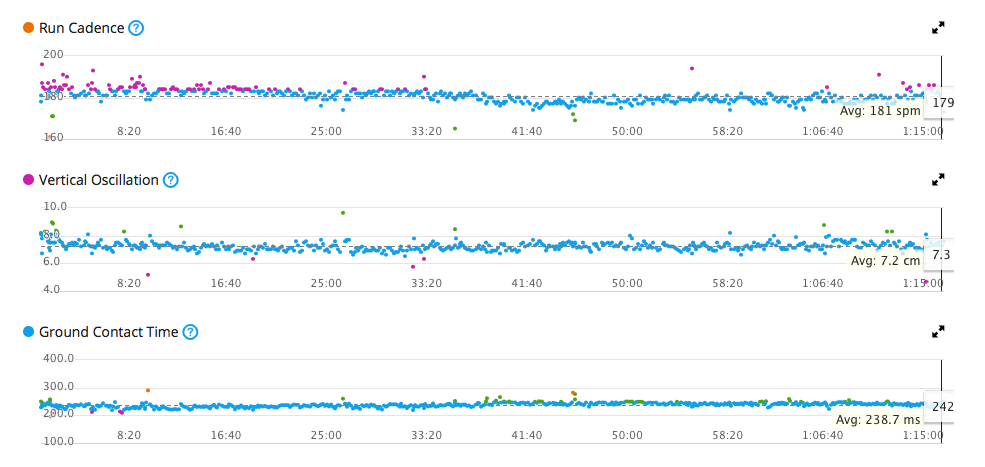
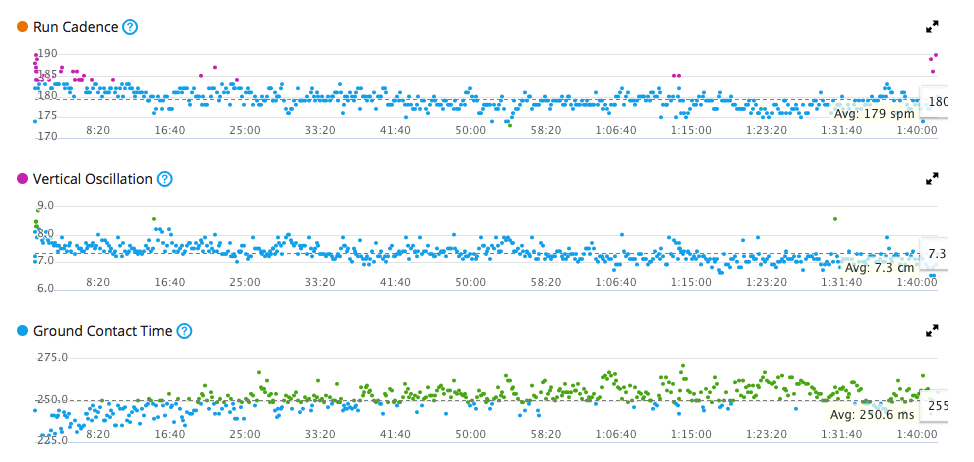
<p><span style="font-size: 16px;">First let's look at the data from the training run. In particular the three graphs which show what are called "run dynamics." These are run cadence, vertical oscillation, and ground contact time. I presume that people are familiar with the idea of cadence, which is simply steps per minute. Note that Garmin measures this as footfalls per minute, whereas many others use steps per minute. A step is simply two footfalls, one left and one right, so if you want the steps per minute number simply divide by 2. Vertical oscillation is a measure of how much your body is rising and falling with each stride. Lower values are better here, as a higher number indicates expending energy to lift you body rather than drive it forward. The ground contact time is also an efficiency measure. The longer your foot stays on the ground, the greater the breaking effect. The Garmin colour scheme for these graphs is, from worst to best, red, orange, green, blue, purple. </span></p>
<p><span style="font-size: 16px;">Here are the graphs from my training run. In the cadence you can see that I was working my legs a bit harder early in the run, and then settled into a fairly consistent stride. The vertical oscillation and ground contact time tell a similar story. In all three graphs there is a fairly strong sense of a consistent level of performance, with occasional glitches. I felt like I was running smoothly and easily and the data seems perfectly consistent with that impression </span></p>
<p><span style="font-size: 16px;"><img alt="Run Dynamics Good Run.png" src="http://maskit.net/rundembear/runninglondon/Run%20Dynamics%20Good%20Run.png" width="985" height="467" class="mt-image-none" /><br /></span></p>
<p><span style="font-size: 16px;">For the race day the data tells a very different story. The colour scheme is fairly similar except for the ground contact time. What is noticeably absent, however, is the level of consistency. Starting with the cadence, it is clear that I was struggling to keep my feet moving in any sort of rhythm. After the opening push my feet kept slowing down, perhaps not enough to have been noticeable to an outside observer, but obvious in the graph. As the race went on the problem got worse, but even in the first 20 minutes you can see a pattern of slowing followed by a burst of over-compensation, a brief period of improvement, although still mediocre, and then another slowing. The vertical oscillation tells another part of the story. In general, as my cadence slowed my vertical oscillation worsened. This makes sense. I was coming further off the ground, thus slightly lengthening the time between steps resulting in a lower cadence. Another way to read this data, though, is that the times of slower cadence were actually when I was trying to push myself to increase my speed, but was actually making things worse by pushing myself higher off the ground. This interpretation makes a lot of sense, and fits in neatly with the idea that running is harder when you are trying to consciously run rather than allowing your body to do what it knows how to do. My mental process through a lot of this race was to try to relax into the running, believing that the magic from the training run would reappear and whisk me along (this is the belief in unicorns part). When that speed didn't happen I panicked a bit and tried to manufacture the speed through effort. The data is telling me that the harder I was working, the worse my mechanics became. If I correlate these graphs against my pacing I can see that the times when my cadence was low and my vertical oscillation was high my pace did increase. Since that pace increase was coming at the cost of much higher effort it simply wasn't sustainable. The data from the ground contact time doesn't correlate well with the other graphs, but is indicative of my generally failing to keep my feet nimble, having a complete lack of consistency, and worsening through the race. Even without all of that analysis, a cursory comparison of the two sets of graphs shows neat lines from the training run, and a noisy mess from the race.</span></p>
<p><span style="font-size: 16px;">While it isn't a pretty picture, the data shows very clearly what went wrong in the race. It also shows why my attempts to correct matters during the race felt so tiring. I had gone into race day with a hope that I would easily find the ease and pace I had experienced in training, and when that failed to materialise I had no plan B. </span></p>
<p><span style="font-size: 16px;"><img alt="Run Dynamics Bad Race.png" src="http://maskit.net/rundembear/runninglondon/Run%20Dynamics%20Bad%20Race.png" width="974" height="462" class="mt-image-none" /><br /></span></p>
<p><span style="font-size: 16px;"> </span></p>
<h1>Injury Effect</h1>
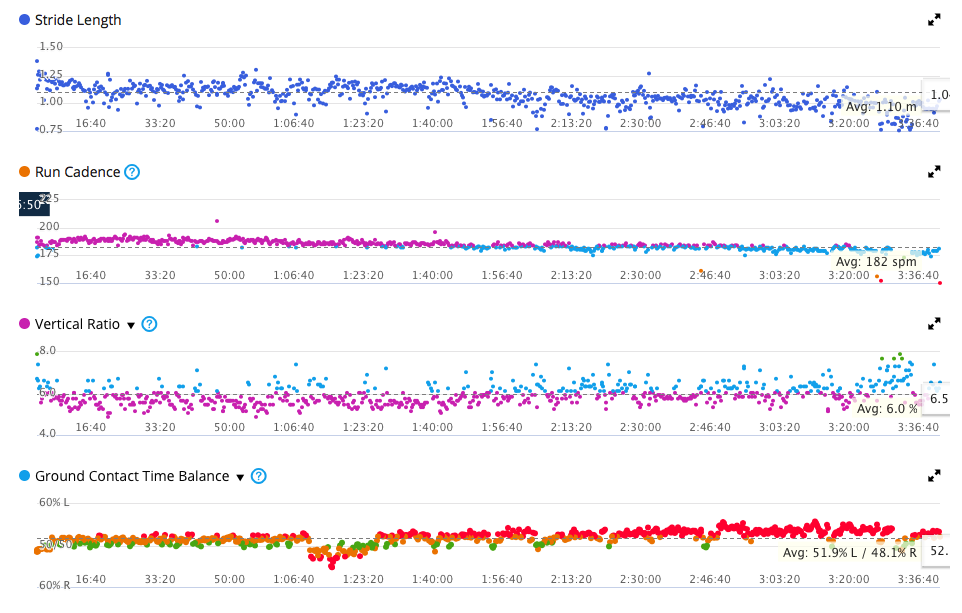
<p><span style="font-size: 16px;">The <a href="http://maskit.net/rundembear/runninglondon/2016/09/mental-mindtricks-and-meditative-marathoning.html">2016 Berlin Marathon</a> was a highly succcesful race for me in a number of ways. I felt comfortable for a lot of the race, my mental approach opened up new possibilities, and I finished feeling quite happy. The one thing that didn't happen, though, was the PB time I had been hoping for. Almost as soon as I crossed the finish line I became aware of a soreness in my inner thigh/groin which had surfaced in my final track sessions. I suspected that this injury, although I hadn't been aware of it during the race, might have been the culprit. Fortunately Garmin had expanded the scope of their run dynamics, perhaps as a result of my switching to their newer heart rate monitor and sensor strap when I changed watches. In any case I now had access to a new graph showing Stride Length, the traditional Run Cadence, and enhanced versions of Vertical Oscillation and Ground Contact Time which now appear as Vertical Ratio and Ground Contact Time Balance. </span></p>
<p><span style="font-size: 16px;">The first thing that stands out for me in these graphs is that my stride length is very inconsistent, and my Ground Contact Time Balance is not very good. I suspect that these two things are related. One of my most stubborn physical challenges as a runner is my hips. They are quite tight, and distinctly asymmetric. My left hip works closer to the way I believe hips are meant to operate, and I believe that I tend to generate more power while running with my left leg than with my right. </span></p>
<p><span style="font-size: 16px;">The Run Cadence and Vertical Ratio are both fairly good here. There is a clear reduction in cadence and worsening of vertical ratio over time, but that seems unsurprising over marathon distance. The change in the dynamics after 3:20:00 is due to my walking a chunk of that last stretch. </span></p>
<p><span style="font-size: 16px;">The bigger part of the story is told by the Ground Contact Time Balance. For the first hour this balance looks like it may be as good as I can manage. There is clearly work to be done here, but this is at least consistent and tightly grouped. Then something happened. I don't know what. I wasn't aware of this happening at the time, but all of a sudden I started favoring my left (injured) leg. From this point onward I was apparently struggling to regain my equilibrium. There was a clear price paid in pace from this point forward. I believe that this graph shows that the injury was bothering me far more than I was aware. Either I was trying to compensate by working that leg harder, or perhaps I was spending more time on that leg as I wasn't able to move off of it as quickly as I had when it wasn't acting up. In either case this change was subtle enough to likely not have been visible to an observer, yet strong enough to have cost me some speed. Tantalizingly, this graph also seems to indicate that there is still a fair amount of improvement I can potentially make in my stride,</span></p>
<p><span style="font-size: 16px;"> </span></p>
<p><span style="font-size: 16px;"><img alt="Run Dynamics Berlin 2016.png" src="http://maskit.net/rundembear/runninglondon/Run%20Dynamics%20Berlin%202016.png" width="962" height="613" class="mt-image-none" /> </span></p>
<h1>Conclusions</h1>
<p>In addition to being a useful tool to validate, or contradict, your impressions of what happend on a run, this data can be very useful in understanding where to focus your attention in your attempts to become a better runner. It is reassuring to see that a very good run was in fact one where mechanics and stride efficiency were good. It is also reassuring to see that a poor run is often connected to something going wrong with mechanics. While there is some thinking that goes into analyzing this data, it is hopefully the case that the data itself connects with what your body has already been telling you and is thus useful even if you aren't a data geek. </p>
<p></p>
<p><span style="font-size: 16px;"> </span></p>
<p></p>]]>
        
    </content>
</entry>

<entry>
    <title>Training With a GPS Watch, Part 1</title>
    <link rel="alternate" type="text/html" href="http://maskit.net/rundembear/runninglondon/2017/05/training-with-a-gps-watch-part-1.html" />
    <id>tag:maskit.net,2017:/rundembear/runninglondon//2.34</id>

    <published>2017-05-05T09:34:59Z</published>
    <updated>2017-08-01T11:43:55Z</updated>

    <summary>I have had a number of conversations with people about ways that I use my GPS watch to support my training. This post is about common features that I use which others may not be aware of. It may also...</summary>
    <author>
        <name>Daniel Maskit</name>
        
    </author>
    
    
    <content type="html" xml:lang="en-us" xml:base="http://maskit.net/rundembear/runninglondon/">
        <![CDATA[<p>I have had a number of conversations with people about ways that I use my GPS watch to support my training. This post is about common features that I use which others may not be aware of. It may also be the case that I use a feature in an unexpected way. I'm sure that there are lots of people out there who know a lot more about using these watches than I do, and I'd love to hear from you about your tips and tricks. In the meantime, I want to share some of what I have figured out and how I use it in my training.</p>
<p>Apologies for this, but these posts will be on the long side, and quite technical. </p>
<h2><span style="font-size: 1.5em;">An Important Weakness</span></h2>
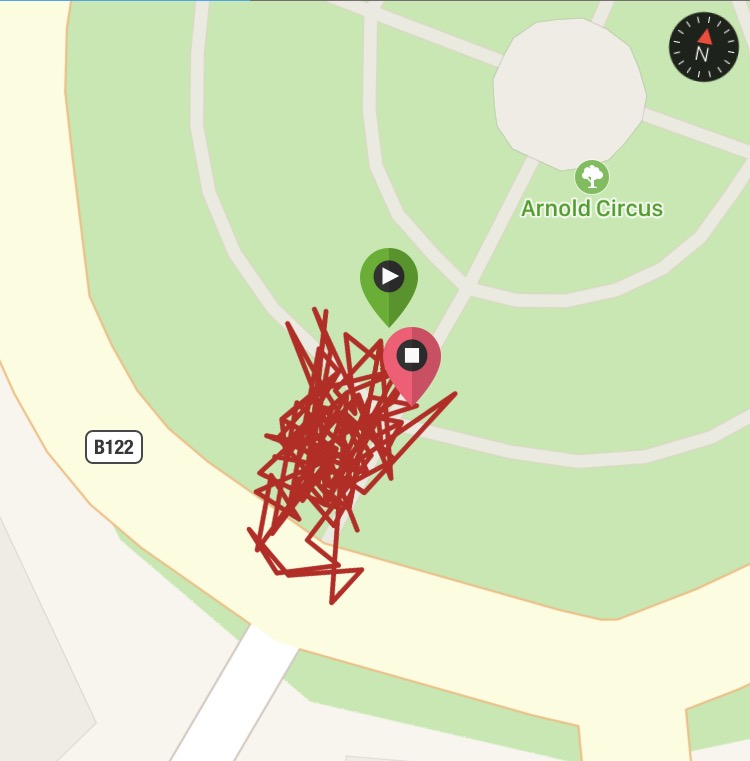
<p>To start with, I would like to discuss something at which GPS is very poor: keeping track of your position when working in a small space. How small is small? Well, it turns out that something as small as a standard running track is too small. I went through a longish period of denial during some track workouts, trying to justify the discrepancy between what my watch was measuring as 1 kilometer, and what was clearly marked as 2.5 laps on the track. Eventually I did some research and located a number of articles, such as <a href="http://running-advice.com/blog/?p=1516">this</a>, which explain that GPS watches have problems acquiring accurate positional data on a track. This also means that if you are relying on the watch to tell you how fast you are on the track, it is probably misleading you. To illustrate how extreme the positional tracking problems can be I am going to show you a GPS track from one of my workouts. As you can see this looks a lot like a ball of yarn after the cat has played with it. Rather curious as this workout was a session in which all I was doing was single-leg step-ups. During the entirety of this workout I was simply stepping on and off a park bench. I doubt that I ever strayed outside of a one meter radius from where I started. Until I had looked at this track I had been thinking that the distance travelled during each segment of the workout was actually telling me something about how hard I was working. In fact it was purely a reflection of how poorly GPS handles this situation. </p>
<p></p>
<p><img alt="arnoldcircusworkout.jpg" src="http://maskit.net/rundembear/runninglondon/arnoldcircusworkout.jpg" width="566" height="636" class="mt-image-none" style="display: block; margin-left: auto; margin-right: auto;" /></p>
<p></p>
<p>An unfortunate result of this weakness in the GPS capability is that one of the most useful features of the watch, the ability to program in one's workouts, is of limited use for track sessions.</p>
<h2><span style="font-size: 1.5em;">Pre-Programmed Workouts</span></h2>
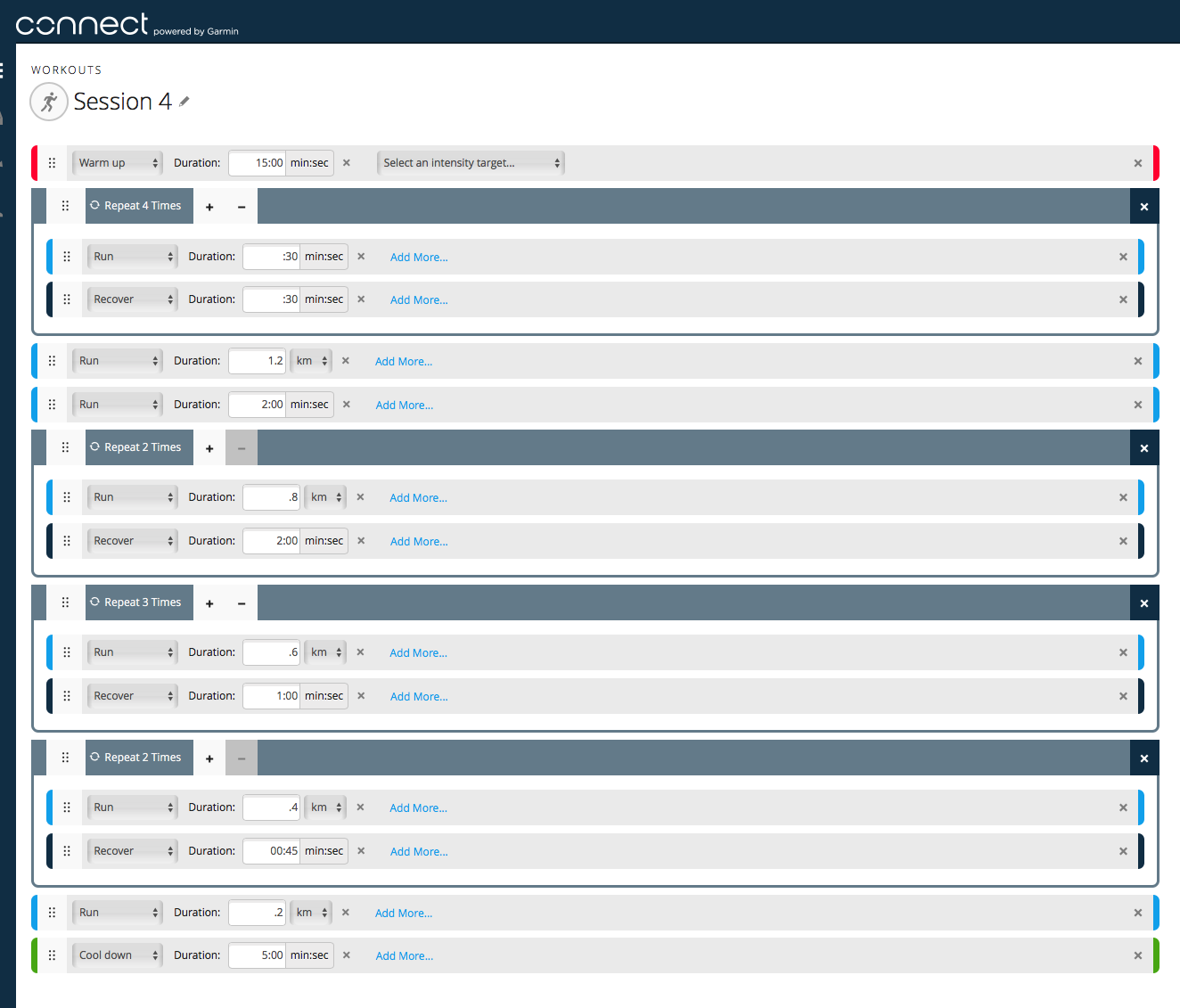
<p>Most of us, at some point in our training, have structured workouts which require keeping track of some combination of times, distances, and repeats. Here is an example of a workout from my coach:</p>
<pre><strong>Warmup</strong>:  Run 15min at extended endurance pace. Run four repeats of a 30 second acceleration followed by a 30 second recovery jog.<br /><br /><strong>Main Session</strong>: Run 1.2km at threshold pace. Run two minutes jogging. Run two repeats of 800 meters at V02 max pace with a two minute recovery jog. Run three repeats of 600 meters at V02 max pace with a one minute recover jog. Run two repeats of 400 meters at anaerobic pace with a 45 second recovery jog. Run 200 meters all out. <br /><br /><strong>Cool Down</strong>:  Finish off with an easy five minute run </pre>
<p><br />That's a lot to try to remember while you are in the midst of a hard workout. Also, sticking to the prescribed rest periods takes more willpower than I personally possess. The solution? Put the watch in charge. I believe that it is fairly standard on GPS watches designed for running that there is some way to create custom workouts. For Garmins this is done on the Garmin Connect website. I presume that other brands have a comparable facility. My watch also has an Intervals feature in which I can program simple workouts directly on the watch. In general, the tool for building a workout lets you specify each step individually, and allows you to insert commands to repeat any set of steps. Here's what the above workout looks like in the Garmin builder:<br /><br /></p>
<p><img alt="session 4.png" src="http://maskit.net/rundembear/runninglondon/session%204.png" width="828" height="714" class="mt-image-none" style="display: block; margin-left: auto; margin-right: auto;" /></p>
<p>That only took a few minutes to create, and once it is on my watch I can just pick it off a list of workouts and it will control my watch. During each piece of the workout the watch can display how much is left in the section. It will count down either time, distance or calories. You can also say that a section lasts when you hit a target heart rate (either pushing you heart rate up to a level, or allowing it to fall down to a level), or when you hit the lap button on the watch. If you were to click on the 'Add More...' for any step you can set a target for pace, speed, cadence, or heart rate. The watch can then be programmed to let you know when you are above the target, below it, both, or neither. I usually don't use the targets as I find the extra alarm beeps distracting, but can see scenarios in which they would be very useful. </p>
<p>In practice, one of the great things about these programmed workouts is that I don't have to worry about how much further to go, or how many more minutes before I change pace. I can focus on technique, mental calm, managing pain, etc. and let the watch tell me when to progress to the next step. Also, when it starts each new step it displays what you are supposed to do. So if you lose track of where you are in the workout this will remind you. Since I am not using the intensity goal alarms I still have to remember how hard to push each sprint, but that is really all I need to remember. I have thus reduced this entire workout into my remembering: threshold, vo2, vo2, anaerobic, all out. And that's assuming that I am actually capable of distinguishing between those last three paces.</p>
<p>The astute above you will have already seen the problem with this workout. Clearly a workout like this, where I am sprinting intervals, is a natural for a track session. But we already established that asking the watch to properly measure distance on a track won't work that well. So we have two choices. One choice is to find someplace with a straight stretch long enough that you can run 600-800 meters in a straight line. This choice often leads to my doing these workouts along the northern Thames Embankment here in London. Not ideal as it is pavement, not flat, and right next to a busy road. the south bank is a bit further from the road, but tends to have a lot more people on it. I can also go up to Victoria Park, which has the benefit of having some very large grassy patches as well as long stretches of coninuous pavement without a road crossing. The benefit of finding a long straight stretch to run is that you can then ask the watch to measure distance. The other option is to remove the distances from the workout, and switching all of those segments to 'run until lap button pressed.' This means that you have to remember the distance for each leg as well as the intensity. On the plus side using the track markers to measure the intervals is the most accurate measurement you will get. </p>
<h2><span style="font-size: 1.5em;"> Heart Rate </span></h2>
<p>I believe that this is one of the most misunderstood aspects of training. I certainly know that I was clueless about it when I got my first watch with a heart rate monitor. First I went online and found the various formulas to calculate max heart rate (all along the lines of 220 - your age). Then I started wearing the monitor and looking at the data which was quite puzzling as I seemed to be exceeding my max heart rate. What does that even mean? Am I harming myself? These were the questions that initially led to my working with my coach. It all started with a phone conversation and her telling me that I needed to come into her gym for a stress test to determine what my max heart rate was. As well as my heart rate zones, something which I had noticed on the watch but really didn't understand. In my case the measured max heart rate was close to twenty beats per minute higher than the calculated rate. It turns out that all of those formulas are very rough approximations that work out some sort of average with no consideration of how fit one is. More importantly, these formulas are based on a bell curve, which means that they are weighted towards the average person. The closer you get to extremes of being fit or unfit the less acccurate these simple formulas.</p>
<p>The heart rate zones turn out to be one of the most important components of training and becoming a better runner. Which isn't to say that you can't gain the same knowledge without using heart rate data, but it can be incredibly helpful. My training breaks down into basically four different types of run, with some variations. These types are: recovery, long run, tempo run, speed interval. Within tempo run there are gradations related to pace appropriate to specific distances (5k, 10k, half-marathon, marathon). Within speed interval there are gradations of intensity level as I mentioned above, ranging from threshold to all out. The trick is that you ideally want to be able to calibrate for yourself how each of these difference paces feels. You also want to ensure that you are working at the right intensity level for a specific workout. This is where the old adage about most runners running their long runs too fast and their speed intervals too slow comes in. </p>
<p>The slowest runs, the recovery run, are intended primarily to loosen up muscles and to increase blood flow to aid recovery. These runs shouldn't involve either cardio work, or adding to the muscle damage from which you are trying to recover. The best way to ensure these goals is to make sure that you keep your heart rate in your lowest zone. For me this zone is up to 84% of max heart rate. These runs can feel very slow and too easy. Learning to trust what feels like recovery pace can really help the rest of your training. Anyone using the Maffetone method will be spending a lot of time running in this zone. </p>
<p>I should note that the specifics of how my heart rate zones are structured, as well as how those zones are used in constructing a training plan, are highly personalized.  A big part of my coach's job is determining the proper mix of intensities that should go into my training for a day, week, month, etc. These decisions are based on her knowledge of not just the science, but of the specifics of where I am in a training cycle, how my body will respond to different types of workout, etc. My training plans are very much tailored to me. I offer the percentages here just as a reference point and do not suggest that others would benefit from using zones or training that mimics mine. </p>
<p>Long runs are meant to be a bit harder than recovery runs, but not a lot harder. This is one of those almost magical, and quite counter-intuitive, aspects of a proper training regimen. Somehow if you do your long runs easy to accustom your body to moving for long periods of time, and do your speed work hard getting your body used to running fast, this becomes an ability to run long periods of time at a speed above your long run pace. The purpose of the long run is not to practice running race pace for long periods of time. The purpose is to accustom you to working moderately for a long time. The trick for long runs is to get yourself away from worrying that your race time will be too slow at the pace you currently running, and embrace the idea that the challenge is running comfortably for hours. For me this means running at around 85% of max heart rate. This is actually a very thin band to run in. A couple of beats per minute slower and I drop into recovery zone. A couple of beats per minute faster and I am crossing into race zone. The benefit of this zone being so thin is that it really encourages smoothness and consistency over one's long runs, which is exactly what you want to be cultivating. </p>
<p><span>Then you have your tempo runs, which are pushing up into that 87-92% zone where you would want to be for a half-marathon, 10k, and 5k. Marathons, for me, right now at least, are on the cusp around 85-87% effort. </span></p>
<p><span>Finally you move into the world of speed intervals. These generally vary from hard to 'oh my god I am going to die.' These workouts are meant to stress several of your body's systems: the system that clears lactic acid out of your muscles; the system that delivers fuel to your muscles; and the cardiovascular system. The challenge with speed work is that it hurts. The good news is that speed session tend to be relatively short, and they tend to translate into a faster race pace fairly quickly. </span></p>
<p><span> </span>When I am working with a heart rate monitor I often have the watch set up to show me the current heart rate. The goal is to be able to run within a zone purely by feel, but I find that I periodically need a refresher in what each zone feels like. I also will carry this approach into a race, especially a marathon. Rather than letting the watch distract me with pace and elapsed time, I have it just showing me heart rate information. This way I can tell at a glance whether my effort is at the correct level, or whether I need to push harder or back off a bit. It is reassuring when the race starts to feel hard to see that this is a result of my having pushed my heart rate too high. </p>
<h2><span style="font-size: 1.5em;"> Intervals </span></h2>
<p>I mentioned these above as a special subset of programming workouts. Intervals are something that you can set up directly on the watch, but only for very simple workouts. All you can put in for intervals is the rule for one type of work, one type of recovery, and optional warm-up and cool-down. Sometimes my workouts are structured along the lines of "N minutes at tempo pace, M minutes at extended endurance pace, repeat 3 times." This is a natural fit for intervals. The tempo portion is the interval, the extended endurance is the recovery. Similarly, if you are running 800 meter repeats with a 40 second rest, that is easy to program into the watch (with the caveat above about using the watch to measure the 800 meters if you are on a track). Running a ladder or pyramid would require programming a workout instead.</p>
<h2><span style="font-size: 1.5em;"> Navigation </span></h2>
<p>This is a feature that I have only started using very recently. I'm preparing for a race which will be on an unmarked course. The organizers will provide a written description of the course as well as a file containing the GPS data for the course. I was contemplating bringing a handheld GPS with me, and then realised that I had the option of downloading the course onto my watch. The process of getting a file onto your watch will vary based on the type of watch you won. The good news is that there are probably instructions for your watch somewhere on the internet. If you also have a Garmin Fenix 3, instructions are <a href="http://dret.typepad.com/dretblog/2016/01/uploading-routes-to-garmin-fenix-3.html">here</a>. </p>
<p>If you use a Garmin (and I presume this is true for other watches as well), there is a way to convert a run that you have done in the past into a 'course' which will allow you to use that past route for navigation. For Garmins you can look at a track using the Garmin Connect website, for example here is one of my <a href="https://connect.garmin.com/modern/activity/1885817183https://connect.garmin.com/modern/activity/1885817183">tracks</a>. If you are logged in to Garmin you should see a gear icon near the top right of the page. If you click on this gear there is a dropdown menu which includes a choice for 'Save as Course.' Selecting that option brings you to a screen where you can name the course, select some options, and save to your account. You can then download the course to your watch. </p>
<p>However you got the course onto the watch, you can now use it to navigate. You can either start a run and then go to pick a course (this is recommended if you are running a race with laps and you will need to restart the navigation after each lap), or you can pick a course and then start a run. I'm not going to go into the details of how to do either of these unless I hear that people have a need for such information. Once you are in navigation mode you have all of the usual display pages for your run, as well as having a map page which shows you where you are, which direction you are headed, and the shape of the course ahead. The watch will also notify you about upcoming turns, as well as sounding an alert if you stray off-course (and again when you are back on course). </p>
<p>I won't say that the navigation is a perfect solution as there are some definite drawbacks. First off, the battery definitely seems to drain faster in navigation mode. Secondly, it can take several minutes to load a course to the point where the watch is ready to navigate. Even if you pause a run using 'Resume Later' the watch will need this chunk of time to reload the map when you resume. Otherwise, the navigation seems to work well. It is definitely reassuring to be able to see that one has not wandered off course, and to know that the watch will complain if you start to go wrong. </p>
<p><span>Next time I will talk a bit about the data your watch can gather for you while you are running and show a couple of examples of how this data can be useful in analyzing performance.</span></p>
<p></p>
<p></p>
<p></p>
<p></p>]]>
        
    </content>
</entry>

<entry>
    <title>Midnight Run Through London</title>
    <link rel="alternate" type="text/html" href="http://maskit.net/rundembear/runninglondon/2017/04/midnight-run-through-london.html" />
    <id>tag:maskit.net,2017:/rundembear/runninglondon//2.33</id>

    <published>2017-04-28T10:30:57Z</published>
    <updated>2017-04-28T11:00:29Z</updated>

    <summary>I haven&apos;t been posting here for a while as my writing efforts have been focused on creating a book. There&apos;s still work to be done, but I have over 35,000 words sitting in Scrivener (a really great editing and organization...</summary>
    <author>
        <name>Daniel Maskit</name>
        
    </author>
    
    <category term="london" label="london" scheme="http://www.sixapart.com/ns/types#tag" />
    <category term="rundemcrew" label="run dem crew" scheme="http://www.sixapart.com/ns/types#tag" />
    
    <content type="html" xml:lang="en-us" xml:base="http://maskit.net/rundembear/runninglondon/">
        <![CDATA[<p>I haven't been posting here for a while as my writing efforts have been focused on creating a book. There's still work to be done, but I have over 35,000 words sitting in <a href="http://www.literatureandlatte.com/index.php">Scrivener</a> (a really great editing and organization tool for writers) and it is starting to feel real. I've sent a short piece in to the editors of <a href="http://www.likethewindmagazine.com">Like The Wind Magazine</a> in the hopes that it will make the cut for the next issue, and that is a piece of text that will grow into a longer version for the book. In the meantime, here is a short kinetic piece I wrote earlier this week which I hope you will enjoy.</p>
<p><span> </span></p>
<p>London Marathon is always a big event for <a href="http://www.rundemcrew.com">Run Dem Crew</a>, and the Tuesday night session afterwards is filled with stories of people's marathon journeys. This year was especially emotional as we not only had three of the participants from the BBC '<a href="http://www.bbc.co.uk/mediacentre/proginfo/2017/17/mind-over-marathon">Mind Over Marathon</a>' project present to receive their marathon medals, we also had two young men who had run the marathon in honour of our fallen comrade <a href="https://www.justgiving.com/crowdfunding/thomas-pace-CROSBIE">Pace</a>. There were tears, applause, deep emotional sharing. We celebrated the futures of people who are struggling and celebrated the memory of our friend who lost his battle with depression. After nearly three hours the last speech had been made, and it was far too late for a group run so everyone started heading home. I was exhausted. I was emotionally drained. Yet I didn't feel right going home. I got out my gloves, tied my jacket around my waist, turned on my watch and headed out into the night. <br /><br />It was cold. The air was crisp. The sky mostly cloudless. I set off at a savage pace. Driving my legs hard, flying through the the late night Shoreditch crowd. Quick left onto Commercial road and down to Spitalfields, Petticoat Lane. Aldgate. Stopped for the lights. Panting and feeling the burning of the cold air on my throat. Not for the first time, and certainly not for the last, a voice in my head told me I needed to slow down. Then the lights changed. And I resumed my speed. Pushing myself. Reveling in the pain. Words from the evening echoing through my head. Thoughts of how lucky I am to be alive. How fortunate to feel this pain and to know that I can make it stop but I choose not to. The Highway. More panting. Tower Bridge. Across the river. Down the stairs. Look across at The Tower, a glistening jewel on the north bank. Stop to take s selfie, big grin on my face. Then off again. Past City Hall. Reveling in the clear night sky. Deep breaths of cold air. My mind still with my Crew. An almost overwhelming sense of vitality. Every step an affirmation that the stars above are here to watch over me. This dark and cold an embrace, an affirmation of life, not an abyss. The Golden Hind. Stop and catch my breath. Millennium Bridge. Loving the stillness of the city. All this space with so few people on the embankment. Consider crossing the river and heading home. But I haven't run far enough yet. <br /><br />Blackfriars. Oxo Tower. Darkened pavement. Trees. Stars. Waterloo Bridge. Walk up the stairs. Fast across the bridge. Down the stairs. Brief pause. Now coughing is mixing in with the panting. This cold air is burning my throat. It's glorious. Past Somerset House. Almost to Blackfriars. Detour back onto roads as construction has closed the path. Every pause to catch my breath renewing my need to take off at speed when I go. My legs feel battered. My feet sore from slapping against the cold, hard pavement. I'm now sweaty enough that stopping means really beginning to freeze. Yet the cold is not my enemy. The cold is here to remind me what it feels like to be alive. Keep pushing. Feel. Blackfriars again. Back down to the river. Cruising, the speed coming that little bit easier now that my legs  are warmed up. Reminding myself to keep my arms high and steady. The burning in my throat and chest. Millennium Bridge. Up the stairs. Sprint. Wait for the light. Pant. Cough. Sprint. Wait for the light. Pant. Cough. Sprint. Race past St. Paul's. Through the shopping centre. Five miles gone. Twists and turns. Through the Guildhall yard. On to London Wall. Moorgate. Last push. A slight detour to eat up my remaining minutes. Past 10k. 45 minutes done. At my front door. Legs aching. Throat burned. Wracked by coughing. Home. Alive. Exultant.<br /><br /></p>
<p><span> <img alt="IMG_7535.JPG" src="http://maskit.net/rundembear/runninglondon/IMG_7535.JPG" width="640" height="640" class="mt-image-none" style="display: block; margin-left: auto; margin-right: auto;" /></span></p>
<p><span> </span></p>]]>
        
    </content>
</entry>

<entry>
    <title>Mental Mindtricks and Meditative Marathoning</title>
    <link rel="alternate" type="text/html" href="http://maskit.net/rundembear/runninglondon/2016/09/mental-mindtricks-and-meditative-marathoning.html" />
    <id>tag:maskit.net,2016:/rundembear/runninglondon//2.32</id>

    <published>2016-09-28T09:04:57Z</published>
    <updated>2016-09-29T08:07:05Z</updated>

    <summary>This past weekend I ran the Berlin Marathon for the third time. The first time my friend Ed Shattock paced me to what is still my marathon PB (as told in Blazing Through Berlin). The second time was a bit...</summary>
    <author>
        <name>Daniel Maskit</name>
        
    </author>
    
    <category term="marathon" label="Marathon" scheme="http://www.sixapart.com/ns/types#tag" />
    <category term="meditation" label="meditation" scheme="http://www.sixapart.com/ns/types#tag" />
    <category term="mindfulrunning" label="mindful running" scheme="http://www.sixapart.com/ns/types#tag" />
    <category term="mindfulness" label="mindfulness" scheme="http://www.sixapart.com/ns/types#tag" />
    <category term="running" label="running" scheme="http://www.sixapart.com/ns/types#tag" />
    
    <content type="html" xml:lang="en-us" xml:base="http://maskit.net/rundembear/runninglondon/">
        <![CDATA[<p>This past weekend I ran the Berlin Marathon for the third time. The first time my friend Ed Shattock paced me to what is still my marathon PB (as told in <a href="http://maskit.net/rundembear/runninglondon/2013/10/blazing-through-berlin.html">Blazing Through Berlin</a>). The second time was a bit of a fiasco as I unwittingly ran the race with a 103° fever (see <a href="http://maskit.net/rundembear/runninglondon/2014/10/grappling-with-grippe.html">Grappling with Grippe in Berlin</a>). This time I decided to try a really different approach to racing and set my goals for the race not on finish time but on my success in spending as much of the race as possible in a 'flow' state, and on enjoying this race more than I have some past races. <br /><a href="http://maskit.net/rundembear/runninglondon/2013/10/blazing-through-berlin.html"></a></p>
<p>I have spent a lot of time this year thinking about what I feel is my greatest weakness as a runner which I would describe as 'succumbing to negative mental chatter.'  This issue turns up fairly late in races (I've had a bunch of DNFs after completing 70-80% of a race) and is generally the result of entering a downwards mental spiral as both body and mind fatigue. It starts out with concern about how long the current kilometer is taking, then moves on to constant recalculation of projected finish time based on all future kilometers being at least this slow, then contemplation of how many hours of suffering this might entail, and worry that I have slowed down even more while I was worrying so I check my watch again and start recalculating, and despairing, and recalculating, and despairing, and eventually the idea of continuing on past the next checkpoint seems like a very bad idea. Then I start worrying about whether I can even reach the next checkpoint. And back around and down my mind spins. Somewhere in this process all objectivity is lost. All ability to analyse what is really going on and what might fix it is banished. The only ray of hope is the possibility of eventually being allowed to stop. </p>
<p>Fortunately in marathons things don't ever get quite that bad as I am fit enough that I know that I can get through 26.2 miles even on a bad day, and I know that there are neither mountains nor long, very steep hills to be reckoned with. Even without the full downward spiral, a marathon can still become a very unfun activity if one allows this negativity to run unchecked. </p>
<p>One easily silenced piece of chatter is the constant data stream from technology. I disabled the audible alarms on my GPS watch so that it does not beep at me (thus drawing my attention to it) every time it thinks I have covered another kilometer. Once I started the race I almost immediately set the watch to display only data related to my heartrate. This is a good indication of how hard one is working and is useful to both encourage me to work harder and to serve as a guide when I am working too hard. This simple change had a profound impact on how the race felt. One of the biggest problems with GPS watches is inaccuracy.  I generally find myself noticing, and worrying about, the difference between when my watch thinks I have completed a kilometer and when I actually pass a kilometer marking on the course. One of the ramifications of this difference existing is that if you are using the watch as a guide to pace then you are being mislead, and probably running slower than you realise. The comparative mental quiet I found by simply allowing the course markings to be the only data I had about distance covered was quite calming. Unexpectedly I found that simply removing this whole idea of 'watch kilometers' and 'course kilometers' allowed me to feel much more present within the race.</p>
<p>This still leaves the problem of how to corral negative thoughts as the race gets tough. Some number of years ago I heard a radio interview with <a href="https://en.wikipedia.org/wiki/Bill_Shoemaker">Bill Shoemaker</a> who was for many years the top horseracing jockey in the world. The interviewer asked Mr. Shoemaker what it was that he did during races that made him so exceptionally good. His response was essentially 'as little as possible.' He went on to explain that the horse knows how to run and how to race, that the jockey is mostly a passenger, and that the job of the jockey is secondarily to offer small bits of advice and encouragement to the horse, and primarily to stay out of the horse's way. I think this is a good metaphor for the role your brain should play while running races. In my experience it is often the case that when running feels hard I am consciously trying to run and thus interfering with the more efficient stride my body would have without my interference. This is where meditation enters the picture. Meditation is all about quieting the mind, being present in the moment, and observing the state of one's body without seeking to alter it. Sounds like the perfect antidote for my negative mental chatter. There was just one small problem: on race day I had been doing daily ten minute meditation sessions for all of thirty-five days. </p>
<p>My approach to the race was very simple: from the start pick an object in the distance (the <a href="https://simple.wikipedia.org/wiki/Siegessäule">Siegessäule</a> makes a very convenient first point) and focus on that object while trying to enter a meditative state. Once the object was too close or the course turned, pick the next object, repeat. I had a fair amount of success with this, and had some longish stretches where I really felt very light and easy as I ran. There really were stretches were I felt like I was observing that my body was running which is quite different from feeling like I was running. Very uncharacteristically I actually missed some of the kilometer markings and was then surprised to discover that I was further along the course than I had thought. All good for the first half of the race, although one does expect that to be the easy bit. The second half got tougher, and I did have some moments of wondering why I was doing this race, although I also had long stretches where I felt amazing and really felt like meditation was carry me to my best-ever finish. When I felt physically challenged or mentally negative I tried to return my attention to a point of focus and expended some effort trying to quiet my breathing. As I  fatigued, mentally more than physically, it was progressively harder to reassert mental calm, but I never stopped trying. While my focus did waver, I found that I could at least turn my mind from negative thoughts onto the attempt to reclaim focus and calm. The major impact of the mental fatigue was that I found myself dropping more and more into an awareness of the gap between kilometer markings and was definitely aware that some of them seemed very far apart. Fortunately I wasn't allowing my watch to tell me how long each kilometer actually was taking, so I wasn't overly disturbed by this.  In retrospect the apparent lengthening of the kilometers was partly mental fatigue, and partly simple reality as I was in fact slowing down. The stretch from kilometer 38 to kilometer 40 seemed to take forever. When I finally hit kilometer 40 and saw the time on the clock I realised that the only possible way I was going to get a PB would be to run sub-4:00 kilometers and that definitely wasn't going to happen. Had I been focused on time this would have been upsetting. Instead I took this fact as permission to take it easy for the last stretch and actually walked a bunch of the forty-first kilometer. This was not head down, beaten, depressed walking though. This was head high, big grin on my face, soaking in the atmosphere and reveling in a sense of accomplishment walking. I then ran nice and easy for the last stretch, soaked in the experience of running through the <a href="https://en.wikipedia.org/wiki/Brandenburg_Gate">Brandenburg Gate</a>, and cruised across the finish line feeling happy. </p>
<p>Almost as soon as I had crossed the finish line and let myself really relax I realised not just how tired I was, but how much my right leg hurt. Right in that spot I had tweaked on track a couple of weeks ago. That niggle I thought had gone away. Oh, maybe that had something to do with slowing down. Sure enough a look at my Garmin data (which I was allowed now that the race was over) shows that I was favoring that leg for more than half the race. I hadn't had any awareness of pain, but my body had definitely adjusted to protect it. The truly intriguing question this raises is whether the mental tricks I was playing somehow silenced the part of my brain that might have tried to use the leg as an excuse to slow down more and walk more. Given that my brain will generally try to lie to me about things being wrong when they aren't, it is almost shocking that I wasn't even aware that something was actually wrong during the race. </p>
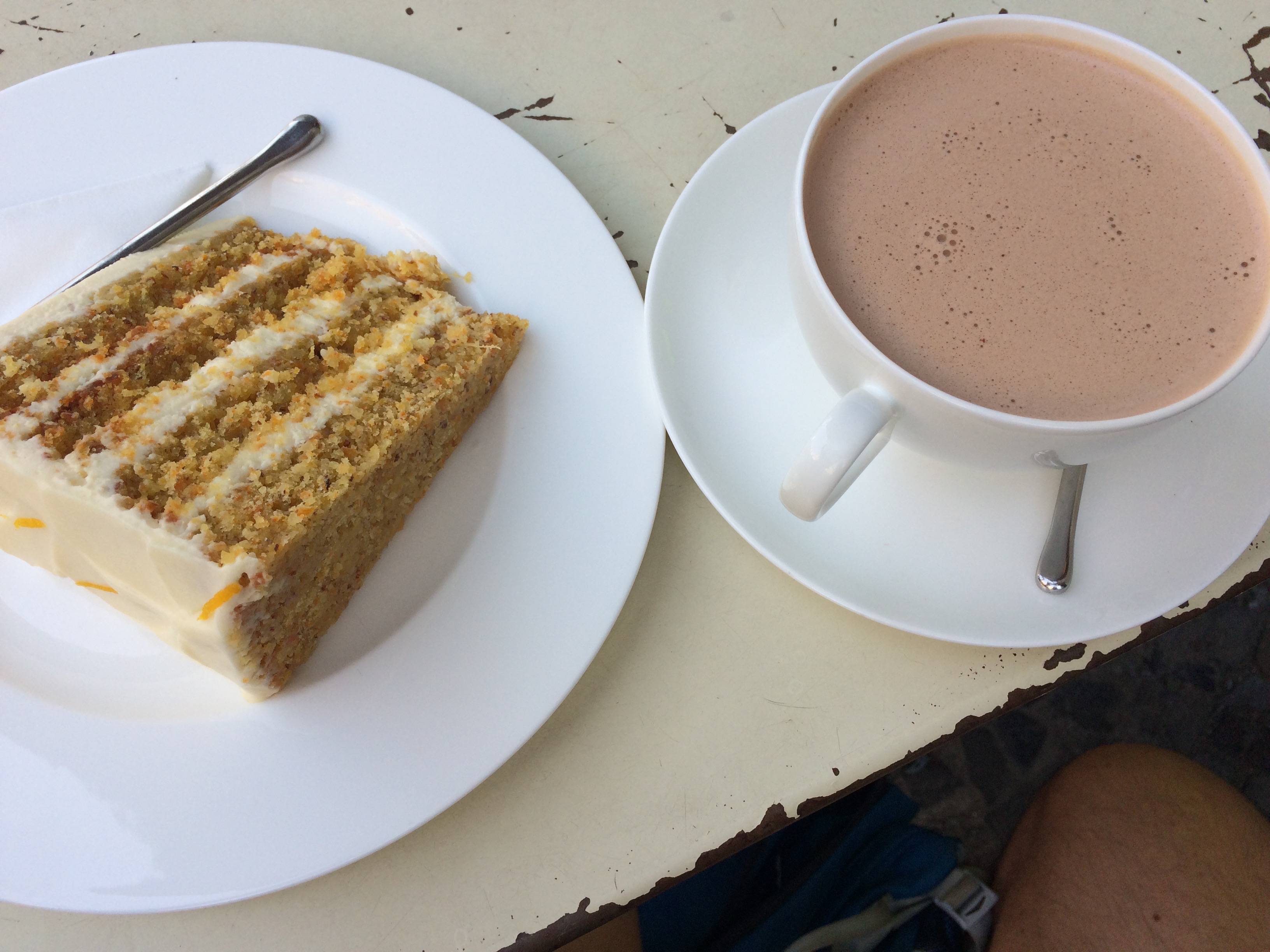
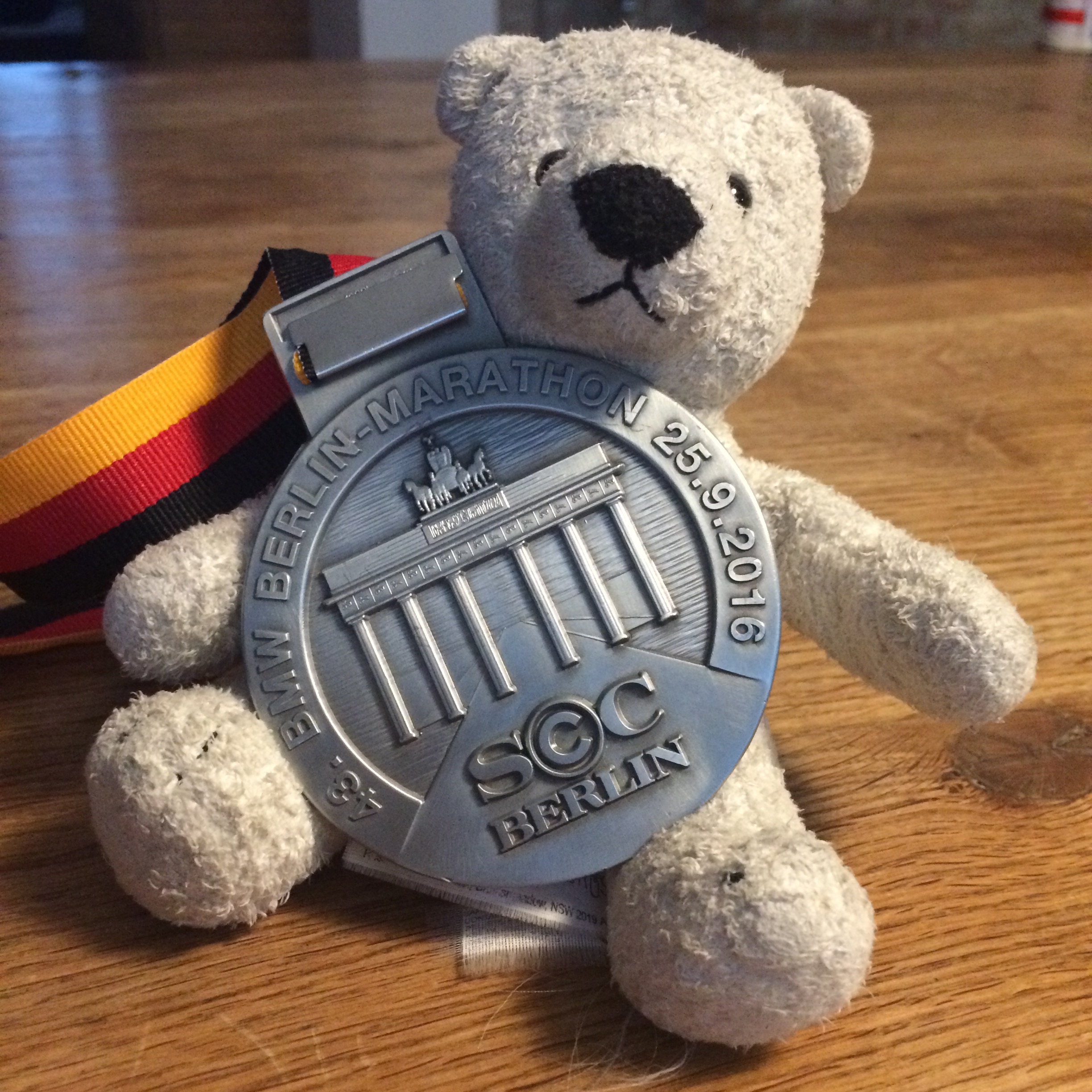
<p>I definitely plan on continuing daily meditation to improve my mental strength, and look forward to seeing how useful these techniques are in future races. In the meantime I can very much celebrate not just running a decent race (coming in with a 3:36:46 for those who care), but an enjoyable one. And then there was cake. And a bear.</p>
<p></p>
<p><img alt="Berlin 2016 Cake.jpg" src="http://maskit.net/rundembear/runninglondon/Berlin%202016%20Cake.jpg" width="381" height="241" class="mt-image-none" />                <img alt="Berlin 2016 Bear.jpg" src="http://maskit.net/rundembear/runninglondon/Berlin%202016%20Bear.jpg" width="382" height="242" class="mt-image-none" /></p>]]>
        
    </content>
</entry>

<entry>
    <title>Musings on Speed</title>
    <link rel="alternate" type="text/html" href="http://maskit.net/rundembear/runninglondon/2016/07/musings-on-speed.html" />
    <id>tag:maskit.net,2016:/rundembear/runninglondon//2.30</id>

    <published>2016-07-31T21:49:13Z</published>
    <updated>2016-07-31T21:55:05Z</updated>

    <summary> It was a bitter cold winter&apos;s night. My first real run with Run Dem Crew elites. We set out at a pace I didn&apos;t think I could handle, but I so wanted to fit in that I just kept...</summary>
    <author>
        <name>Daniel Maskit</name>
        
    </author>
    
    
    <content type="html" xml:lang="en-us" xml:base="http://maskit.net/rundembear/runninglondon/">
        <![CDATA[<p></p>
<p><span>It was a bitter cold winter's night. My first real run with Run Dem Crew elites. We set out at a pace I didn't think I could handle, but I so wanted to fit in that I just kept pushing myself harder and harder to keep up. I vividly remember the moment my watch beeped indicating the end of a kilometer and I had a tiny fraction of a second to register that this had only taken 3:45, just over a 6:00/mile pace. I'm not this fast, I thought. And then I just kept running. We had a couple of brief stops for traffic lights, and finally rocketed into Trafalgar Square barely seventeen minutes after leaving Shoreditch. I am shattered. I am in shock. I am so grateful for a rest. After a bit of waiting around for other groups to show up, and some quick photo taking, we need to get moving. We are now freezing as our sheen of sweat starts moving towards becoming a sheath of ice. Back the same way? Of course not. Off to the Embankment where the front of pack rockets off to take advantage of over a mile of uninterrupted pavement. I can't keep up, but I won't give in. I just keep running as fast as I can. A voice in the back of my head tells me there is no point. They are gone. You'll have to finish the run on your own. Finally Millenium Bridge comes into sight, almost time for a break. But what's that sound? Clapping? Oh my, there the rest of the group is. Waiting for me. Clapping for me. Welcoming me back into the fold. </span></p>
<p><span>It was a warm, humid summer London night. I'd been running with Run Dem Crew elites for about six months and every week was still stretching me to my limit. We hit Victoria Park and I had to just bear down and accept that this was going to be painful. The thing about Vicky Park is that it's about a three mile (5K) loop with no need to stop. The pack flew out ahead of me and I just focused on technique, kept my eyes on the people I was close enough to keep in sight, and hoped for the leaders to decide to stop just to have a stop as that was the only mercy I was going to get. Finally, about half-way through the loop I was tremendously relieved to see the group clustered around a water fountain and not continuing to pull away from me. I kept up the suicide pace I was running as long as I could, gratefully pulled to a stop and turned to Jeggi. I wanted to say "You have no idea what it cost me to do that last bit." Then I saw his face and the coin dropped: he knew full well. Because it wasn't just me that was dying on this run, it was everyone else too. The </span><span>camaraderie</span><span> and support I had been feeling from these guys and girls for months suddenly made a lot more sense. They weren't looking at the slow guy (#slowestOfTheFast) and thinking "well, for him that was okay" they were recognizing that I was putting out at least the same level of effort that they were.</span></p>
<p><span>That was a turning point for me, but it was also just one more small step in the journey. The truth is that part of who I am as a runner was forged in the crucible of showing up every Tuesday night for over a year knowing full well that three things were going to be true: 1) I was absolutely going to get my ass kicked. This was going to hurt and there was nothing I could do to prevent that. 2) As long as I gave it my all I was going to be warmly welcomed when I rejoined the group that had temporarily left me in their dust. 3) At the end of it all, I was going to feel both shattered and elated. </span></p>
<p><span>On these runs there is no time for self-pity, no time for anything but focusing on technique because that is the only thing that will get you through the run. If you are thinking about pain, if you are thinking about how hard it is, you need to think about something else. There's no time for pain. Your brain will cry out for mercy, and you need to find a way to tell it "I don't have time to have this conversation now." Your brain will tell you that you can't keep running this fast, and you need to prove it wrong.</span></p>]]>
        
    </content>
</entry>

<entry>
    <title>Usually The Mountain Wins</title>
    <link rel="alternate" type="text/html" href="http://maskit.net/rundembear/runninglondon/2015/06/sometimes-the-mountain-wins.html" />
    <id>tag:maskit.net,2015:/rundembear/runninglondon//2.29</id>

    <published>2015-06-30T19:22:03Z</published>
    <updated>2015-07-05T09:56:45Z</updated>

    <summary> Never before have I taken so little comfort from the 40km marker in a marathon. Usually this marker is a sign stating that you are just about done. A sign telling you to dig down for one final push,...</summary>
    <author>
        <name>Daniel Maskit</name>
        
    </author>
    
    
    <content type="html" xml:lang="en-us" xml:base="http://maskit.net/rundembear/runninglondon/">
        <![CDATA[<p><img alt="Brixen Top 1.jpg" src="http://maskit.net/rundembear/runninglondon/Brixen%20Top%201.jpg" width="530" height="497" class="mt-image-none" style="display: block; margin-left: auto; margin-right: auto;" /></p>
<p></p>
<p style="text-align: left;"><span>Never before have I taken so little comfort from the 40km marker in a marathon. Usually this marker is a sign stating that you are just about done. A sign telling you to dig down for one final push, no need to fear the pain and effort, it will all be over soon. This wasn't that sort of sign at all. This one seemed like a fairly pointless marker placed at a seemingly arbitrary point in a rock field. A steeply angled rock field. A rock field I had to get myself to the top of. If I turned around during one of my fairly frequent pauses to take deep breaths trying to compensate for the lack of oxygen, I could see the aid station at Kilometer 39, several hundred meters below me. Passing through that station over twenty minutes earlier seemed a distant and abstract event. Another five minutes or so should get me to the top, I thought. The time estimate was fairly good, the use of definite article less so. This wasn't 'the' top, it was just a top. And there was still one more climb left in this race. Only at Kilometer 41, another 100 meters higher, was I finally told that the rest of the way to the finish was flat. Which meant I could run it, at least as much as the thin air allowed.</span></p>
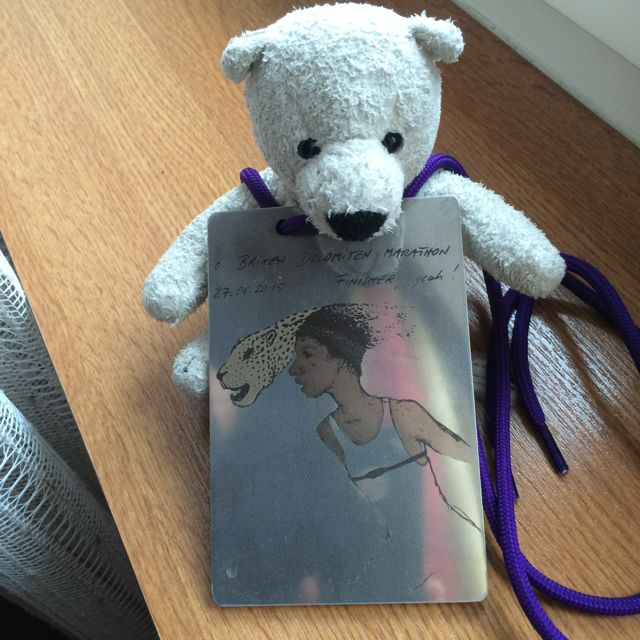
<p><span>The last time I ran a </span><a href="http://maskit.net/rundembear/runninglondon/2013/07/the-bear-went-over-the-mountain-and-back-to-chamonix.html">mountain marathon</a><span> the experience was humbling. So while I had great hopes as I headed to the Südtirol, the German-speaking region of northern Italy, to run the </span><a href="http://www.brixenmarathon.com/en/">Brixen Marathon</a>, I also was prepared for a very long day<span>. The Brixen course tops out at 2486 meters (8156 feet), and has almost no downhill. Most of the run is at fairly high altitude (1000 meters at 10K, 1500 meters around 15k, above 2000 meters from 29k to the finish). I was quite calm and relaxed pre-race. I knew it was going to be tough, and I knew I could handle it. The major question in my mind was whether I was going to be able to control the way I ran the race, or if the mountain was going to dictate terms. If I was able to run most of the first large climb I felt that I could run the race I wanted. With this question in mind I started fairly fast for the initial flat section, and attacked the first climb. Bad plan. By ten miles in I was tiring, and the elevation was starting to bother me. Well before the halfway point I felt beaten. I never doubted that I would get to the finish line, but I knew that it would only happen by giving in to the mountain. While I might be strong enough that I could have run much more of the race at a more restrained pace, my ambitious attempt to do more just resulted in tiring myself out. And throughout it all I knew that I needed to have energy left for the last big climb. </span></p>
<p><span>On the plus side, I ran a much stronger race than I ran two years ago. Despite the altitude, despite the relentless uphill course, despite the prohibition on trekking poles (which had really helped me two years ago) I took a full forty minutes off of my previous mountain marathon time. Clearly I am nowhere near strong enough to get through a race like this without extended periods of power hiking, but I am mentally tough enough to keep myself continually moving forward. I am also mentally tough enough to have gotten through this race without external support. While I did stop and take a couple of pictures along the way I avoided the social media I had relied on last time out. Sometimes a bear has to find his own way up the mountain.</span></p>
<p><span> </span></p>
<p><span><img alt="Bear Brixen Medal.jpg" src="http://maskit.net/rundembear/runninglondon/Bear%20Brixen%20Medal.jpg" width="436" height="454" class="mt-image-none" style="display: block; margin-left: auto; margin-right: auto;" /> </span></p>]]>
        
    </content>
</entry>

<entry>
    <title>Sometimes DNF Stands for Definitely Not Failure</title>
    <link rel="alternate" type="text/html" href="http://maskit.net/rundembear/runninglondon/2015/05/sometimes-dnf-stands-for-definitely-not-failure.html" />
    <id>tag:maskit.net,2015:/rundembear/runninglondon//2.28</id>

    <published>2015-05-27T19:22:41Z</published>
    <updated>2015-06-03T19:05:12Z</updated>

    <summary>There is a well-known quotation often attributed to Michelangelo (although there is some dispute about the attribution) which goes: &quot;The greater danger for most of us lies not in setting our aim too high and falling short; but in setting...</summary>
    <author>
        <name>Daniel Maskit</name>
        
    </author>
    
    
    <content type="html" xml:lang="en-us" xml:base="http://maskit.net/rundembear/runninglondon/">
        <![CDATA[<p>There is a well-known quotation often attributed to Michelangelo (although there is some dispute about the attribution) which goes: </p>
<p style="margin-left: 30px;">"The greater danger for most of us lies not in setting our aim too high and falling short; but in setting our aim too low, and achieving our mark."</p>
<p>This seems like an excellent sentiment for endurance athletes. I often remark that the nice thing about ultras, as compared to marathons, is that you don't worry so much about time. You line up at the start line and mentally award yourself a gold model if you finish the event. A very different state of mind from having a goal time for a marathon. However, as with times in a marathon, if you always have a 'gold medal' race this likely means you aren't challenging yourself enough in your event choice. Combine this line of thought with my common advice to focus on the question 'Did I run the best race I could run today?' and you can begin to understand how it is that I can hold my head high after finishing 'only' 88km of this year's London 2 Brighton 100km Challenge. I know that some runners view taking a DNF (Did Not Finish) as a failure. I feel that they are wrong to do so.</p>
<p>I had a fantastic day in the country running with my friend Jason. The weather was just about perfect: comfortable temperature, dry, just overcast enough that I didn't feel baked by the sun. The course was mostly beautiful country, ranging from the River Thames from Richmond down to Kingston to the countrysides of Surrey and East Sussex, with some nice pieces of trail thrown in from time to time. The staff at the aid stations were really great, and the food choices were generally excellent. I ran a much stronger fifty miles than I had run last year, and definitely had my nutrition plan working much better. Despite having been really good about nutrition for the first 45 miles or so, I then made a couple of errors. First off around 45 or 46 miles in I found myself thinking that I should reach into a pocket, get out some food, and eat something. I failed to follow through on that thought. Big mistake. Without eating often enough, your body starts shutting down your digestive system, and at that point your race is basically over. Yes, you can slog through to the finish, but it will be tough and slow. Coming into the 80km checkpoint I was starting to lag, and then I tried to force myself to eat, but I went right for the hot food which was jacket potatoes, when I probably needed something with more rapidly available carbs. Then I added cheese, which added protein into the mix, something which my stomach was definitely not up for handling. A couple of miles later I was feeling ill, tired, and generally beaten. Just couldn't keep running. I did manage to walk to the 88km checkpoint (and Jason scored major points by sticking with me even though I tried to send him on his way), but I was beaten.</p>
<p>At this point I had a choice: stick with what I had accomplished, start recovering, and call it a day; or push on, have hours of tough slogging to the finish, risk injury, dehydration (I wasn't keeping food down so this was an actual risk), etc. If I hadn't finished this very race last year I might have felt I had something to prove, but that wasn't an issue. I'd already learned a great deal, and knew where I had gone wrong. I didn't seem likely to learn anything more by pushing on. So I called it a day. Spoke to the excellent medical staff. Had a little Coca-Cola to settle my stomach and spike my blood sugar. Ate some fruit. Spoke with staff and other runners. Took a shuttle to the finish line so I could be there to greet Jason when he came in. The result of this is that I felt fine the next day. A little sore, very tired. Hungry! Ready to start recovering and turn my attention to my next race.  It's a lot like setting out to run a sub-3:30 marathon and 'only' running a sub-4:00. Did you miss your goal? Sure. Do you still feel a sense of accomplishment? You should. Did you just do something most people can't even imagine? You betcha. Did Not Finish, true, but Definitely Not a Failure.</p>]]>
        
    </content>
</entry>

<entry>
    <title>Not Twenty Six Laps: One Lap, Twenty Six Times</title>
    <link rel="alternate" type="text/html" href="http://maskit.net/rundembear/runninglondon/2015/05/not-twenty-six-laps-one-lap-twenty-six-times.html" />
    <id>tag:maskit.net,2015:/rundembear/runninglondon//2.27</id>

    <published>2015-05-26T21:55:35Z</published>
    <updated>2016-12-23T13:45:53Z</updated>

    <summary> As many of you know I recently undertook an interesting training challenge. Here in London it is difficult to get in a lot of hill training because, frankly, the city is fairly flat. This poses interesting challenges for the...</summary>
    <author>
        <name>Daniel Maskit</name>
        
    </author>
    
    
    <content type="html" xml:lang="en-us" xml:base="http://maskit.net/rundembear/runninglondon/">
        <![CDATA[<p><img alt="Flatline Marathon 3.jpg" src="http://maskit.net/rundembear/runninglondon/Flatline%20Marathon%203.jpg" width="640" height="554" class="mt-image-none" style="display: block; margin-left: auto; margin-right: auto;" /></p>
<p></p>
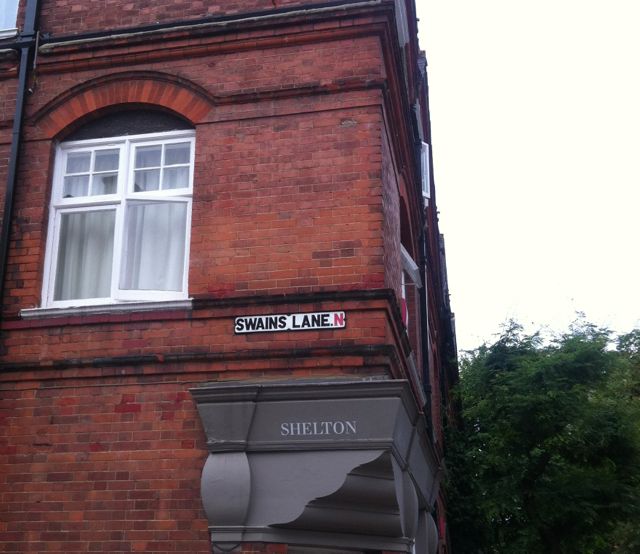
<p>As many of you know I recently undertook an interesting training challenge. Here in London it is difficult to get in a lot of hill training because, frankly, the city is fairly flat. This poses interesting challenges for the Londoner training to run in the mountains. The <a href="http://www.energylab-bts.com">EnergyLabs</a> solution to this problem is <a href="http://www.goinggoingbike.com/blog/the-great-road-climbs-of-london-swains-lane/">Swains Lane</a> or, as we call it, Swains Lane of Pain. We don't quite do the entire hill as the cyclists do, but instead run the top 800 meters. This makes each lap very close to a full mile. The standard challenge is the Flat Line race that EnergyLabs sponsors These are ten laps of this hill. As I am training to run a mountain marathon in June, I decided that ten laps wasn't enough of a challenge. So the Saturday morning before the <a href="http://www.virginmoneylondonmarathon.com/en-gb/">London Marathon</a> I headed up to Swains Lane and set off to run a full marathon. Twenty-six laps, plus a could of hundred meters of flat at the very end.</p>
<p>I've been asked a lot of questions about this, mostly 'why?,' 'are you mental?,' or 'how did you do that?' The best I can do in the way of answers is that I did it because it needed to be done; and I probably am mental, but more to the point the way I did this was entirely mental. People make the mistake of thinking this was a physical challenge, but in truth it was much more of a mental one. My approach was simple in concept, but hard to execute. All it involves is not running twenty-six laps, but runnng one lap, twenty-six times. The rules are simple: on the way down the hill you can think all you want about how many laps you have done, how many are left, etc. But on the way up there is always only the one lap you are doing right now. The magic of this approach is that if you think about how many you have done your body will feel more fatigued; and if you think about how many you have left your mind will begin to despair. You can very quickly go from feeling fine to feeling crushed. As long as you focus on just running the one uphill you are running right now, however, all is fine.</p>
<p>I did break the race down a bit as well. I decided up front that the timing would be on training run rules, not race rules. That means if I stopped for a break I stopped my watch, and restarted when I started running again. Using these rules I ran the first thirteen laps straight through. Then I took a bit of a break as it was warmer than planned and I needed to go buy some water. Then I ran seven more laps, and took a short breather. Finally I ran the last six straight through. I had flirted with the idea of taking a short break after lap twenty-three, but decided that giving myself permission to take the break, and then not taking the break, provided a mental lift due to showing strength more potent than the physical lift I would have gotten from actually taking a break. The most surprising part of this whole endeavour was how well this mental technique worked. The combination of the second half of every mile being the uphill part (Flat Line always starts going downhill first), and the mental technique requiring every uphill being <em>the </em>uphill meant that the miles simply flew by. I never had that experience one so often has in road marathons of feeling like a mile is dragging on. Nor did I have the experience of hitting extreme fatigue or muscle soreness, although this may be as much due to the slower pace as to anything else. This exercise examplifies what I mean when I speak of being half bear/half machine. Half of the exercise was the strength to just keep running and running, the other half was the mental control to keep my brain out of the way and let the machine drive. </p>
<p></p>


<blockquote class="instagram-media" data-instgrm-captioned data-instgrm-version="7" style=" background:#FFF; border:0; border-radius:3px; box-shadow:0 0 1px 0 rgba(0,0,0,0.5),0 1px 10px 0 rgba(0,0,0,0.15); margin: 1px; max-width:658px; padding:0; width:99.375%; width:-webkit-calc(100% - 2px); width:calc(100% - 2px);"><div style="padding:8px;"> <div style=" background:#F8F8F8; line-height:0; margin-top:40px; padding:50% 0; text-align:center; width:100%;"> <div style=" background:url(data:image/png;base64,iVBORw0KGgoAAAANSUhEUgAAACwAAAAsCAMAAAApWqozAAAABGdBTUEAALGPC/xhBQAAAAFzUkdCAK7OHOkAAAAMUExURczMzPf399fX1+bm5mzY9AMAAADiSURBVDjLvZXbEsMgCES5/P8/t9FuRVCRmU73JWlzosgSIIZURCjo/ad+EQJJB4Hv8BFt+IDpQoCx1wjOSBFhh2XssxEIYn3ulI/6MNReE07UIWJEv8UEOWDS88LY97kqyTliJKKtuYBbruAyVh5wOHiXmpi5we58Ek028czwyuQdLKPG1Bkb4NnM+VeAnfHqn1k4+GPT6uGQcvu2h2OVuIf/gWUFyy8OWEpdyZSa3aVCqpVoVvzZZ2VTnn2wU8qzVjDDetO90GSy9mVLqtgYSy231MxrY6I2gGqjrTY0L8fxCxfCBbhWrsYYAAAAAElFTkSuQmCC); display:block; height:44px; margin:0 auto -44px; position:relative; top:-22px; width:44px;"></div></div> <p style=" margin:8px 0 0 0; padding:0 4px;"> <a href="https://www.instagram.com/p/15k0HDm9eC/" style=" color:#000; font-family:Arial,sans-serif; font-size:14px; font-style:normal; font-weight:normal; line-height:17px; text-decoration:none; word-wrap:break-word;" target="_blank">Early this morning a bear slipped from his den and headed towards the London Underground. Observers, if there were any, might have noticed a distinct sense of purpose in the bear&#39;s stride. This was a bear on a mission. A #secretmission. The bear was next spotted boarding a bus outside of Archway tube and heading towards the top of some large hills. As the morning wore on reports started to circulate amongst the city&#39;s bicycle community. Those who had turned out for their usual Saturday morning reps of Swains Lane, aka Swains Lane of Pain, aka the Steepest Hill in London, were starting to report that throughout their rides, however long they were, they kept spotting a bear determinedly running up and down Swains Lane. The bear was briefly joined by @thestevenlayton but most of the time was on his own. Those who enquired were told that the bear was running a marathon. Composed of 26 laps up and down Swains Lane. Surely the bear was mad. Surely the bear would falter. Mad he may be, but falter he did not. When asked afterwards why he had done it the bear simply replied &#34;it needed to be done.&#34; The bear expressed hopes that those running the London Marathon tomorrow will draw strength, inspiration, and courage from this simple act of running up and down a hill until the running was done. The bear also expressed a desire that today&#39;s deeds be considered as living up to @robinnyc &#39;s exhortation to #DoEpicShit #secretmission #HalfBearHalfMachine #WhileYouWereSleeping #rundemcrew #energylab #Flatline #Flatline26 #FlatlineMarathon #Bears #Mile21</a></p> <p style=" color:#c9c8cd; font-family:Arial,sans-serif; font-size:14px; line-height:17px; margin-bottom:0; margin-top:8px; overflow:hidden; padding:8px 0 7px; text-align:center; text-overflow:ellipsis; white-space:nowrap;">A photo posted by Daniel Maskit (@rundembear) on <time style=" font-family:Arial,sans-serif; font-size:14px; line-height:17px;" datetime="2015-04-25T13:29:18+00:00">Apr 25, 2015 at 6:29am PDT</time></p></div></blockquote>
<script async defer src="//platform.instagram.com/en_US/embeds.js"></script>
<p></p>
<p></p>]]>
        
    </content>
</entry>

<entry>
    <title>With A Little Help From My Friends</title>
    <link rel="alternate" type="text/html" href="http://maskit.net/rundembear/runninglondon/2015/04/with-a-little-help-from-my-friends.html" />
    <id>tag:maskit.net,2015:/rundembear/runninglondon//2.26</id>

    <published>2015-04-23T18:45:07Z</published>
    <updated>2015-04-23T20:02:01Z</updated>

    <summary> Charlie Dark often points out that &apos;running is a metaphor for life.&apos; One of the myriad ways in which this is true is the extent to which achievements which are often seen as individual triumphs are actually the product...</summary>
    <author>
        <name>Daniel Maskit</name>
        
    </author>
    
    
    <content type="html" xml:lang="en-us" xml:base="http://maskit.net/rundembear/runninglondon/">
        <![CDATA[<p></p>
<p><img alt="Finish2.jpeg" src="http://maskit.net/rundembear/runninglondon/Finish2.jpeg" width="611" height="444" class="mt-image-none" style="display: block; margin-left: auto; margin-right: auto;" /><br /><br /></p>
<p>Charlie Dark often points out that 'running is a metaphor for life.' One of the myriad ways in which this is true is the extent to which achievements which are often seen as individual triumphs are actually the product of a network of support. I have had some experiences over the last month which have reminded me of this fact. My story starts with plans to run the <a href="http://www.endurancelife.com">Endurance Life</a> <a href="http://www.endurancelife.com/event-new.asp?series=85">Coastal Trail Series</a> <a href="http://www.endurancelife.com/event-new.asp?series=85&amp;location=278">Sussex Ultramarathon</a>. I knew that my friend Jason was running this race, and I had arranged to run it with him. Then Jason had to drop out due to work travel. And engineering works made travel to the race complicated. So I landed on taking a <a href="http://www.zipcar.co.uk">Zipcar</a> for the day (now that I have my UK licence) and driving down, although I wasn't keen on a long solo drive, a long race, and another long solo drive. I reached out to my networks looking for someone who would be interested in Jason's race place, and would be good company for the driving. After a false start or two, I ended up arranging to pick up my friend David in Southeast London on my way out to the coast. </p>
<p>Thanks to turn-by-turn navigation on my phone I was able to safely get to the arranged point, pick up David, and head off. In addition to being an endurance runner, David also had tons of practical advice on UK driving and navigation which proved invaluable. I fear that the trip may have gone badly wrong had I not had his support. Talk naturally turned to running. I frecalled some advice I received from Simon Freeman (of <a href="http://www.freestak.com">Freestak</a>) before one of my early endurance races: I should be prepared to experience despair during the race, but this will pass; I would experience times of euphoria during the race, these too will pass. I hadn't thought of this fantastic advice for quite while. It was perfect advice for the day I had ahead of me.</p>
<p><img alt="Cliffs.jpeg" src="http://maskit.net/rundembear/runninglondon/Cliffs.jpeg" width="442" height="431" class="mt-image-none" style="display: block; margin-left: auto; margin-right: auto;" /></p>
<p></p>
<p>The race started in sunshine along a stunning stretch of coast (btw, David took most of the photos that accompany this post). My race strategy was to push as hard as I could early and see how long I could maintain intensity and pace (and of course to see just how much more capable I was after the past months of rigorous preparation by my coach and friend Barbara). I ran up the first couple of hills, only walking when I hit a really large one. Good weather, good conversations with fellow runners, and some almond butter and Jam sandwiches got me through the first seventeen or eighteen miles feeling good. Then there was a long set of very steep uphills, accompanied by very steep downhills, and I really had no choice but to walk a fair bit of it. Despair started to set in. Remembering Simon's advice I reminded myself that my down mood would pass. Upon reflection I was letting being affected by the slowness of walking uphill. Remain patient, I told myself.  Soon there was a long downhill, some flat, and some level running which brought me to the twenty-one mile checkpoint in a great mood. I refilled my water, added some <a href="http://nuun.com">Nuun</a>, and started in on a <a href="http://clifbar.com">Clif Bar</a> as I headed back out. The next few miles were glorious. Beautiful countryside, a long downhill, nice weather (there was a recurrent threat of rain which never actually materialised). I was feeling good and enjoying the run. </p>
<p><img alt="Sussex2015_2.jpg" src="http://maskit.net/rundembear/runninglondon/Sussex2015_2.jpg" width="392" height="521" class="mt-image-none" style="display: block; margin-left: auto; margin-right: auto;" /></p>
<p>Then I bottomed out and started to climb again, and the euphoria was gone. I still felt good, just not euphoric. Soon I was running past the start line (where the marathon runners were peeling off to finish), and headed back out the way we had started that morning. This time around the hills were much tougher and I was walking where I had run earlier. Things got tough, but I just kept focusing on moving along. There were a couple more brief bouts of despair (especially re-running the same sharp hills that I had struggled with earlier; the intervening fifteen plus miles did not make this stretch easier) Again remembering Simon's advice kept me focused and continuing to progress rather than wallowing in despair. When I finally crossed the finish line it was with a great sense of accomplishment and a strong sense of having succeeded at pushing myself all the way through the race. I was met by David's shouts of congratulations and was thrilled to have such a warm greeting.</p>
<p style="text-align: center;"><img alt="Sheep.jpeg" src="http://maskit.net/rundembear/runninglondon/Sheep.jpeg" width="489" height="406" class="mt-image-none" /></p>]]>
        
    </content>
</entry>

<entry>
    <title>Running &apos;Naked&apos; Through Paris</title>
    <link rel="alternate" type="text/html" href="http://maskit.net/rundembear/runninglondon/2015/04/running-naked-through-paris.html" />
    <id>tag:maskit.net,2015:/rundembear/runninglondon//2.25</id>

    <published>2015-04-06T20:57:59Z</published>
    <updated>2015-04-06T21:37:13Z</updated>

    <summary> Sometimes technology is not your best friend on race day. We have become so accustomed to having constant feedback as we make our way through life (any &apos;likes&apos; on my latest Instagram yet?) that we can lose sight of...</summary>
    <author>
        <name>Daniel Maskit</name>
        
    </author>
    
    <category term="paris" label="Paris" scheme="http://www.sixapart.com/ns/types#tag" />
    <category term="racing" label="racing" scheme="http://www.sixapart.com/ns/types#tag" />
    <category term="technology" label="technology" scheme="http://www.sixapart.com/ns/types#tag" />
    
    <content type="html" xml:lang="en-us" xml:base="http://maskit.net/rundembear/runninglondon/">
        <![CDATA[<div><img alt="2015_Paris_Postrace.jpg" src="http://maskit.net/rundembear/runninglondon/2015_Paris_Postrace.jpg" width="480" height="640" class="mt-image-none" style="display: block; margin-left: auto; margin-right: auto;" /></div>
<div></div>
<div><hr /></div>
<div></div>
<div>Sometimes technology is not your best friend on race day. We have become so accustomed to having constant feedback as we make our way through life (any 'likes' on my latest Instagram yet?) that we can lose sight of the real purpose of activities. Running, which at its core is one of the most pure activities an athlete can pursue, is no stranger to technological distractions. The most obvious example of the tension between technology working for you and you working for technology is the sports watch. I hate to run without my trusted Garmin 610, but I am trying to learn how to choose when the watch is in charge. A lot of my training is structured workouts, for which the watch is absolutely brilliant. If I am meant to run a certain time at a certain effort level, and I know that the watch will beep when it is time to switch paces, I can just focus on running. Or focus on thinking about something else. This is definitely the watch working for me. Then there are times when I use the watch as a crutch, the most egregious example of this being on nights when I am supposed to run with the Run Dem Crew elites (think suicide pace) for a limited number of minutes. Some of the worst runs I have had have been twenty minutes with Elites. Why? Well, when you keep looking at your watch to see if you are done yet you are constantly losing your focus, in particular losing a grip on your mental coping techniques for pushing your body to its limit. The effect is compounded when you think you have just done a good long stretch since you last peeked at the watch, and discover it was only 45 seconds. Soul crushing. This same problem arises in races. My current marathon PB was in <a href="http://maskit.net/rundembear/runninglondon/2013/10/blazing-through-berlin.html">Berlin</a> in 2013. In many ways that race was the best marathon I have yet run. My biggest regret was that I didn't listen to my inner voice telling me to hide my watch from myself. A lot of the mental struggle in that race was my dealing with the feedback from the watch, rather than focusing on running as best I could. </div>
<div></div>
<div>I've been training myself to be less dependent on my watch, and working on running longer and longer stretches without paying attention to the data available to me. I took the next step in this process in Paris a few weeks ago. My training this year is focused on strength and endurance. Sure I am still doing tempo runs, but I am not pushing myself to my limit in the pursuit of speed. Which means that while I felt fully prepared to run a respectably fast half marathon, I hadn't specifically trained to run fast at this distance. This seemed like the perfect opportunity to run a complete race without paying attention to anything but the messages from my body. Yet I still wanted to have the data from the run to look through afterwards. So I was wearing my watch, but I had it set to a display which only showed my altitude above sea level, a completely useless piece of data while running through central Paris. In retrospect I could have had a more pure experience if I had switched off the watch feature which beeps every kilometre and shows the time it took to run that kilometre, but I only looked at a few of those times during the race, and didn't adjust my running in response to them. I wouldn't say I truly went 'the Full Monty' as I didn't simply leave the watch at home, but this was quite close to running 'naked,' that is without technology. The result of this was that I crossed the finish line of the race, and honestly did not know what my time was.</div>
<div></div>
<div>The last time I <a href="http://maskit.net/rundembear/runninglondon/2013/03/la-persistance-a-paris.html">ran this race</a> it was cold, my stomach was a little off, and I really struggled. That race is still my half marathon PB, but it felt like a struggle most of the way. This year the weather was nearly perfect, perhaps getting a bit warm by the finish but comfortable (even in vest and short-shorts) at the start. I did get to the starting pen a little late, and as a result ended up stuck behind the 1:35 pace group. I had been thinking that I should be capable of outrunning them, but after expending a bunch of energy trying to get clear of them I gave up and just settled into running comfortably. After about 7km my thighs were starting to ache a bit, and I had this bout of negative thinking along the lines of 'if I am in pain now how awful will this be to run with for another 9.5 miles?' Then I cleared those thoughts out of my head, took an inventory of my technique, corrected my leg stride to be more correct, and the pain vanished. Phew. Once I was back to being pain-free I really started enjoying the run. Sunshine, beautiful city, feeling good. After about 45 minutes I took a short break at a water station, had a few sips of water, gave up about 15-20 seconds of time to walk while drinking, and then got back to cruising speed. The rest of the race passed by with occasional reruns of an inner conversation about whether I should just be enjoying myself, or whether I should be pushing harder. I kept reminding myself that the goal was to run on feel, and the feel was telling me that my pace was respectable. Eventually I settled on a promise to myself that when I hit 20km I would kick up the pace and race the final 1100 metres. This focus on allowing my body's feedback, rather than technology, dictate my thinking about how well I was running was tremendously liberating. I could have had constant feedback telling me I was slowing down a bit, which would have probably triggered negative thinking about how I don't run well in the heat, which would have likely resulted in my slowing down more and struggling. Instead I just kept assuring myself that the feel of how I was running was fine, which allowed me to enjoy the weather and the scenery, and kept my pace steady. This was the first race I have run where after the race others were commenting about how hot it had been, and I was saying how comfortable I had been. As promised I kicked my speed up for the last stretch, flew past people struggling to finish, and crossed the finish line with a big smile. Final time: 1:41:06. Not a PB (but under two minutes off my best time), but a very satisfying and fun run.</div>
<div></div>
<div><img alt="2015_Paris_Bear_Medal.jpg" src="http://maskit.net/rundembear/runninglondon/2015_Paris_Bear_Medal.jpg" width="281" height="410" class="mt-image-none" style="float: right;" /></div>
<div><img alt="2015_Paris_Falafel.jpg" src="http://maskit.net/rundembear/runninglondon/2015_Paris_Falafel.jpg" width="314" height="409" class="mt-image-none" style="float: left;" /></div>]]>
        
    </content>
</entry>

<entry>
    <title>Awaking From Hibernation, Raring to Race a Mile</title>
    <link rel="alternate" type="text/html" href="http://maskit.net/rundembear/runninglondon/2015/02/awaking-from-hibernation.html" />
    <id>tag:maskit.net,2015:/rundembear/runninglondon//2.24</id>

    <published>2015-02-28T09:53:47Z</published>
    <updated>2015-02-28T11:32:13Z</updated>

    <summary>Since running Berlin Marathon with a fever things have been quiet here. I did take another shot at a fall marathon, running Philadelphia in late November, but that race too went off the rails. Despite my hopes I was still...</summary>
    <author>
        <name>Daniel Maskit</name>
        
    </author>
    
    
    <content type="html" xml:lang="en-us" xml:base="http://maskit.net/rundembear/runninglondon/">
        <![CDATA[<p>Since <a href="http://maskit.net/rundembear/runninglondon/2014/10/grappling-with-grippe.html">running Berlin Marathon with a fever</a> things have been quiet here. I did take another shot at a fall marathon, running Philadelphia in late November, but that race too went off the rails. Despite my hopes I was still not back at full strength. I made it to the finish line in an unmemorable time, my major consolations being twofold. First, the timing of the marathon meant that I arrived early at my sister-in-law's house for Thanksgiving, which resulted in my getting lots of time to spend with my brother-in-law who has ALS (or Motor Nueoron Disease as it is known here in the UK). We didn't do much of note (although we ended up going to see Birdman which went on to win the Oscar for Best Picture), but it was great to just spend time with him. Highlights included his introducing me to various incarnations of Dr. Who (I've always been partial to Tom Baker and hadn't previously made the effort to broaden my horizons); and us having a talk about athletic preparation and race performance (Jim swam competitively for Williams College and continued to be passionate about swimming until ALS forced him out of the pool).</p>
<p><br />The other consolation in Philadelphia was the opportunity to spend some time with my dear friend Jeggi and to meet some of his fellow members of Black Roses, a NYC-based running crew. I not only was welcomed to their post-marathon gathering in Philadelphia, but also went running with them in NYC the following weekend. Jeggi, who writes beautifully, captured our friendship and reunion quite well in this Instagram post:</p>
<blockquote class="instagram-media" data-instgrm-captioned="" data-instgrm-version="4" style="background: #FFF; border: 0; border-radius: 3px; box-shadow: 0 0 1px 0 rgba(0,0,0,0.5),0 1px 10px 0 rgba(0,0,0,0.15); margin: 1px; max-width: 658px; padding: 0; width: calc(100% - 2px);">
<div style="padding: 8px;">
<div style="background: #F8F8F8; line-height: 0; margin-top: 40px; padding: 50% 0; text-align: center; width: 100%;">
<div style="background: url(data:image/png; base64,ivborw0kggoaaaansuheugaaacwaaaascamaaaapwqozaaaagfbmveuiiii9pt0ehh4gib4hibkchbwchbwchbydr+jqaaaachrstlmaba4yhyqsm5jtamwaaadfsurbvdjl7zvbegmhcaqbaf//42xcnbpaqakcm0ftumfaaibe81iqbjds3ls6zs3bipb9wed3yyxfpmhrft8sgyrcp1x8ueuxlmznwelfoycv6mhwwwmzdpekhlhlw7nwjqkhc4uizphavdza2jpzudsbzzinae2s6owh8xpmx8g7zzgkeopuoyhvgz1tbcxmkd3kwnvbu0gkhkx+izilf77iofhry1nyfnb/lqpb79drwoyjva/davg9b/rlb4cc+nqgdz/tvbbbnr6gbreqn/nrmdgaqeej7whonozjf+y2i/fzou/qaaaaaelftksuqmcc); display: block; height: 44px; margin: 0 auto -44px; position: relative; top: -22px; width: 44px;"></div>
</div>
<p style="margin: 8px 0 0 0; padding: 0 4px;"><a href="https://instagram.com/p/wDZvblqzlF/" style="color: #000; font-family: Arial,sans-serif; font-size: 14px; font-style: normal; font-weight: normal; line-height: 17px; text-decoration: none; word-wrap: break-word;" target="_top">"I thought that this was going to be a post-marathon recovery run," said @rundembear as we jammed down Kent Avenue en route to Flushing in Brooklyn at 6:50 min/mile pace. I replied,"Sorry." "It's just like Embankment tho innit?" Back in London, alongside the mighty #RUNDEMCREW #ELITES, we used to hammer down the 1.5 mile Embankment stretch from Big Ben to the Millennium Bridge all out chasing the likes of @sorrellwalsh, @eddyshh, @neil_s_phillips, and @bonjourhugo_ almost every Tuesday night. I continued,"I mean, it is just like Embankment but slightly longer." Daniel replied,"That's great but when does this end?" When I was training for the Copenhagen Marathon last year, I ran my longest run up to that point (18 miles) alongside Daniel Maskit. When I finished the run, a convoluted route from Canary Wharf, East London to Wimbledon, South West London, and on a particularly dreary day, he said,"I'm just going to go ahead and run 26 miles." He did it for kicks at the end of a training run. That's sorta one of those things that someone says that you never really forget. To a teammate and fellow pretentious film aficionado, it was immeasurably meaningful to run and spend time with you once again. &lt;3 @rdcbridgethegap #INNIT #BLACKROSESNYC #RUNDEMCREW #GROUPTRAINING #TRAININGMETHODS #NEVERNOTRUNNING #KEEPRUNNINGWEIRD #RUNNINGCULTURE #DEARFRIENDS PHOTOGRAPH: @fredgoris</a></p>
<p style="color: #c9c8cd; font-family: Arial,sans-serif; font-size: 14px; line-height: 17px; margin-bottom: 0; margin-top: 8px; overflow: hidden; padding: 8px 0 7px; text-align: center; text-overflow: ellipsis; white-space: nowrap;">A photo posted by Jegggiiiiii (@paavozatopek) on <time style="font-family: Arial,sans-serif; font-size: 14px; line-height: 17px;" datetime="2014-12-01T05:56:35+00:00">Nov 30, 2014 at 9:56pm PST</time></p>
</div>
</blockquote>
<p>
<script async="" defer="defer" src="//platform.instagram.com/en_US/embeds.js" type="text/javascript"></script>
</p>
<p></p>
<p></p>
<p>Post Philadelphia I have been focused on recapturing the simple love of running, and gradually returning to training. While last year my focus was on that elusive chase for a better marathon time, this year is about strength and endurance. The main difference is that this year is less about speed and managing the pain of going too fast, and more about distance and managing the pain of going too far. The primary training goal for this year is to strive for being strong enough to be able to complete a 100K race without feeling shattered at the end of it.</p>
<p>While this means that much of my running is based around covering lots of distance, one cannot completely abandon short-term speed. Thus, while I normally favour much longer races, I view the return of the <a href="http://www.cityoflondonmile.co.uk/">City of London Mile</a> as something to welcome and anticipate. A short, fast, and free(!) race through the heart of the city which is our playground. Get in! I was fortunate enough to be invited to the launch event for this race where there was not only the opportunity to reconnect with the charming and enthusiastic Peter and Tom from <a href="http://www.run-fast.net/">run-fast</a> who are the race organizers as well as the creators of London's largest independent running shop <a href="http://www.therunningworks.net/">The Running Works</a>; but also the chance to meet and chat with two-time Olympian and current 800m world record holder Anthony Whiteman (that's him in the green jacket):</p>
<p><a href="http://maskit.net/rundembear/runninglondon/IMG_5897.jpg"><img alt="IMG_5897.jpg" src="http://maskit.net/rundembear/runninglondon/IMG_5897.jpg" class="mt-image-none" width="517" height="344" /></a></p>
<p>Once the presentations were done, those of us brave enough to take on the challenge were given a chance to race a mile along the Embankment with (but definitely not against)  Anthony Whiteman. The launch event itself was cozy and warm inside the newly renovated <a href="http://www.amba-hotel.com/hotels/united_kingdom/london/charing-cross/index.html">Amba Charing Cross Hotel</a>, which only made the walk down to the Embankment, especially for those of us in short shorts and vests, seem even colder than it was. We received a quick pre-race briefing (mostly making sure everyone knew which piece of railing underneath the Charing Cross rail bridge was the finish line), and set off to jog the course in reverse as a warm-up. The rules were simple: everyone had given their predicted mile time to Simon Freeman, and our goal was to come as close to that time as we could. With one catch: we had to run 'naked' that is without watches or other timing devices. I had gone for a modest 7:00/mile due to the cold and wet conditions, and thought I had a sense of what running a 7:00/mile pace feels like. Once we arrived at the start we had a few minutes to mill around, and then we were off. Those wondering about logistics for timing such an event will be amused to discover that the secret was a man on a bicycle with a stopwatch! He started the watch when we set off, and then raced off ahead of us to be first to the finish line where he then called off the times as each of us crossed.</p>
<p>I set off at what I thought was the correct pace, and just focused on maintaining that pace all the way through. Part of Mr. Whiteman's talk had been about how one prepares to run a mile, and the importance of consistent pacing for the whole distance. He said that his recommended method for determinine one's expected mile pace is to run ten 400m intervals at a track, with a short recovery between. The goal for this exercise is to run all ten laps at the same pace. If one can actually accomplish this feat, then one knows that one should be able to race a mile in roughly the time it took to run four of those laps. While I don't see myself running consistent 400m intervals any time soon, my takeaway was that I should focus on consistent pacing.</p>
<p>In case anyone was unaware of this, when you are running hard, one mile can be an awfully long distance. And that is, really, the challenge of this race. Anyone who does any level of running should be capable of running a mile. But running a fast mile, that's a whole other matter. The usual mistake people make is to go out too fast, and half-way through realise how far they are from the finish. Which isn't to say you want to go out slow, it would be just as bad to finish feeling that you didn't give it your all. Either scenario, slowing down or speeding up, would not be what a true miler would consider a good race.</p>
<p>Along the Embankment we flew, the pack spreading out as everyone settled into their own pace. The earlier rain lent a beautiful atmospheric feel to the run.</p>
<p><a href="http://maskit.net/rundembear/runninglondon/IMG_6082.jpg"><img alt="IMG_6082.jpg" src="http://maskit.net/rundembear/runninglondon/IMG_6082.jpg" class="mt-image-none" width="515" height="343" /></a></p>
<p>I'm still not sure whether my familiarity with this stretch of the Embankment (I often do my speed work here) was an advantage or a disadvantage. It any case, I had a good sense of how much longer I needed to maintain my pace, focused on approaching bridges and other landmarks (and not on my body's pleas to stop running now), and cruised across the finish line right on pace at, um, 6:41. Or maybe 6:42. What? Didn't expect that. So much for that 7:00/mile pace. So much for any chance at a prize (prizes were given to those whose final time was closest to their predictions). On the plus side, I feel that I won something better than any prize: I learned that I am faster than I think I am! I'll take that.</p>
<p>You can <a href="http://www.cityoflondonmile.co.uk/">sign up now</a> to find out how fast you are. The race is on June 14th, and features special waves for elites, families, youth, and wheelchair athletes. Women have the option of running in the regular City of London Mile or as part of a special all-female wave. The organizers are clearly trying to make this a race for everyone who runs. I hope to see you all there.</p>
<p><a href="http://maskit.net/rundembear/runninglondon/IMG_6106.jpg"><img alt="IMG_6106.jpg" src="http://maskit.net/rundembear/runninglondon/IMG_6106.jpg" class="mt-image-none" width="547" height="364" /></a></p>]]>
        
    </content>
</entry>

<entry>
    <title>Grappling with Grippe in Berlin </title>
    <link rel="alternate" type="text/html" href="http://maskit.net/rundembear/runninglondon/2014/10/grappling-with-grippe.html" />
    <id>tag:maskit.net,2014:/rundembear/runninglondon//2.23</id>

    <published>2014-10-05T13:24:50Z</published>
    <updated>2014-10-07T21:03:38Z</updated>

    <summary> I was quite excited about getting another chance to run the Berlin Marathon. Last year, assisted by the fabulous pacing of Ed Shattock, I battled through pain to register what still stands as my marathon PB. After a year...</summary>
    <author>
        <name>Daniel Maskit</name>
        
    </author>
    
    
    <content type="html" xml:lang="en-us" xml:base="http://maskit.net/rundembear/runninglondon/">
        <![CDATA[<p><img style="display: block; margin-left: auto; margin-right: auto;" alt="Daniel Kit Berlin 2014.jpg" src="http://maskit.net/rundembear/runninglondon/Daniel%20Kit%20Berlin%202014.jpg" class="mt-image-none" height="305" width="305" /></p>
<p>I was quite excited about getting another chance to run the Berlin Marathon. Last year, assisted by the fabulous pacing of Ed Shattock, I battled through pain to register what still stands as my marathon PB. After a year of growth, and some months of very intense training, I was optimistic that this PB would fall. My optimistism (seen pre-race below with Claudia and Rachel) would prove to be misplaced.</p>
<p><img style="display: block; margin-left: auto; margin-right: auto;" alt="Daniel Claudia Rachel Pre Berlin 2014.jpg" src="http://maskit.net/rundembear/runninglondon/Daniel%20Claudia%20Rachel%20Pre%20Berlin%202014.jpg" class="mt-image-none" height="321" width="321" /></p>
<p>The weekend began quite well, with an easy flight from London into Berlin, a smooth transition from plane to train (actually being on a train 30 minutes after my flight got in even though I had checked a bag!), and a lovely welcome and shakeout run with my Bridge The Gap family, hosted by Flo Hoffman (pictured post-race with me below) and Run Pack Berlin. Throughout the afternoon I had conversations with other runners during which I discussed my race strategy and shared my philosophy about running marathons: there are too many variables that you simply cannot control. You can have a desired time, but you shouldn't base your evaluation of success purely on that time. I like to tell people that the goal is to cross the finish line feeling that you ran the best race that you could have run today.</p>
<p><img style="display: block; margin-left: auto; margin-right: auto;" alt="Daniel and Florian post Berlin 2014.jpg" src="http://maskit.net/rundembear/runninglondon/Daniel%20and%20Florian%20post%20Berlin%202014.jpg" class="mt-image-none" height="305" width="305" /></p>
<p>Based on my experiences both in Berlin last year and in London this year, I headed off to the start on Sunday morning expecting to have about two to two-and-a-half hours of fairly comfortable running, followed by forty-five minutes to an hour of mental battle against pain to get to the finish. So it was quite disturbing when barely over an hour into the race I felt like I had no energy left. My legs just felt dead. And I still had about twenty miles to go. While I had no idea at the time what was wrong, subsequent events offer some clarity. I had woken up on race day with a slightly irritated throat due to post-nasal drip. I had written this off as allergies, and hadn't thought too much more about it. By Monday morning I was clearly ill. When I got home Monday night I was running a 101.4 F (38.5 C) fever. In short, I was coming down with something (perhaps a mild case of the flu?). So, there I was, three-quarters of the race still to go, no energy, struggling simply to keep running. This was That Moment. The one you have at least once in every race. That time when you need to answer the question "how much do you want this?" Some would have quit. Some would have cried. Some would choose to soldier on. For someone as stubborn as myself, the last was the only real choice.</p>
<p>The rest of the race was a mixture of struggling to run, walking, drawing as much energy from the amazing support as I could, smiling, high-fiving kids, encouraging other runners. In general making the best of a bad situation. When I finally hit the final kilometer the major thought in my mind was the words of Charlie Dark: what matters isn't how you run the race, it's how you cross the finish line. And I crossed that finish line running, head held high, and feeling quite proud of what I had just accomplished. It certainly wasn't the race I wanted to run, but it was the best that I could have run on that day.</p>
<p></p>
<p><img style="display: block; margin-left: auto; margin-right: auto;" alt="Post Berlin Feed 2014.jpg" src="http://maskit.net/rundembear/runninglondon/Post%20Berlin%20Feed%202014.jpg" class="mt-image-none" height="424" width="318" /></p>
<p><img style="display: block; margin-left: auto; margin-right: auto;" alt="Bear Berlin Medal 2014.jpg" src="http://maskit.net/rundembear/runninglondon/Bear%20Berlin%20Medal%202014.jpg" class="mt-image-none" height="424" width="319" /></p>]]>
        
    </content>
</entry>

<entry>
    <title>Vibram Vilified</title>
    <link rel="alternate" type="text/html" href="http://maskit.net/rundembear/runninglondon/2014/06/vibram-vilified.html" />
    <id>tag:maskit.net,2014:/rundembear/runninglondon//2.22</id>

    <published>2014-06-25T21:04:18Z</published>
    <updated>2014-06-27T11:34:25Z</updated>

    <summary> Last month a settlement was announced in a lawsuit against Vibram. This suit accused the company of making false statements about the health benefits of wearing Vibram Five Fingers (VFF) shoes. As you presumably know these are the shoes...</summary>
    <author>
        <name>Daniel Maskit</name>
        
    </author>
    
    
    <content type="html" xml:lang="en-us" xml:base="http://maskit.net/rundembear/runninglondon/">
        <![CDATA[<p><img style="display: block; margin-left: auto; margin-right: auto;" alt="muddyVibrams.jpg" src="http://maskit.net/rundembear/runninglondon/muddyVibrams.jpg" class="mt-image-none" height="400" width="300" /></p>
<p>Last month a settlement was announced in a lawsuit against <a href="http://www.vibramfivefingers.com">Vibram.</a> This suit accused the company of making false statements about the health benefits of wearing Vibram Five Fingers (VFF) shoes. As you presumably know these are the shoes that I run in, and which I credit for many things including curing my plantar fascitis. Without getting into the nitty gritty of the lawsuit, I do want to speak about some of the issues raised and about my personal experiences. I particularly want to discuss the dubious role played by some podiatrists. The gist of the settlement is that Vibram has agreed to pay penalties, and to refrain from making any claims not based on science, although Vibram has not admitted doing anything wrong. In truth, it is likely to be the case that many, if not all, of Vibram's claims will eventually prove to be true. My belief is that the villains in this case are bad science and bad medicine. I won't go into depth about the science, but will state that I have yet to see a scientific study of barefoot running which has a methodology that makes any sense to me either as a barefoot runner or as a research scientist. One example is an oft-cited <a href="http://www.ncbi.nlm.nih.gov/pubmed/24357642">comparison</a> between minimalist running and running in more traditional running shoes.  This study is so badly designed that none of its results can be considered significant. They took 103 runners, randomly assigned them to different types of shoes, and then had them spend ten weeks training for a 10K race. As far as can be determined, none of these runners had previously run in minimalist shoes. A significant number of the people told to go out and train for a 10K in Vibrams got injured. I could have told them that would happen. Ten weeks is nowhere near enough time to transition to minimalist running.</p>
<p>Despite this sort of shoddy methodology, the negative results are embraced by those who wish to condemn Vibram. Which would perhaps be resonable if podiatrists relied on a scientific basis for their approach to treatment. Oddly, if we were to hold the podiatrists to the same standard to which Vibram is being held, almost everyone who has ever had plantar fascitis (PF) would probably be able to win a malpractice lawsuit. </p>
<p>As many of you know I used to have PF, and minimalist running has cured me. Yet there are people who report that trying to transition to minimalist running causes PF. How can we make sense of these apparently conflicting data points? Let's start by examining what PF is.<br /><br />I looked at a number of sites from respected medical organizations, such as the <a href="http://www.mayoclinic.org/diseases-conditions/plantar-fasciitis/basics/definition/con-20025664">Mayo Clinic</a>.  Every site I found agrees that PF is inflammation of a tendon that runs along the bottom of your foot. But why is that tendon there? The Mayo Clinic says that it is there to support the arch of the foot. But that isn't actually correct. The arch is supported in part by the shape itself, which is how Roman arch bridges work. The rest of the support comes from a set of muscles in the middle of your foot that sit above the arch and pull it upwards. The tendon attached to the bottom of the arch isn't actually supporting the arch, it's stabilizing it: it helps the arch move correctly as your foot changes shape while you are moving. The doctors are correct that PF is a result of the arch being weak, as a weakened arch places more stress on the stabilization mechanism. However none of the recommended treatments for PF involve any measures that would strengthen the muscles in the feet. In fact, one of the most common 'treatments' is to prescribe orthotics. Which provide artificial support for the foot, and restrict the way your foot moves. And what happens when you restrict the movement of muscles? You weaken them. That's right, prescribing orthotics to treat PF might alleviate your symptoms, but they are weakening your feet and making it more likely that your PF will recur. As to the rest of the treatments, while rest seems reasonable enough, standard medical practice is to escalate to steroid injections and surgery rather than exercises to strengthen your feet. And the kicker on all of this? Well, according to <a href="http://www.webmd.com/a-to-z-guides/plantar-fasciitis-treatment-overview">WebMD</a> the effectiveness of the standard treatments for PF have "...not been proved in scientific studies." Which means that Vibram is actually being held to a higher standard than the medical profession.<br /><br />As to VFFs causing PF, this is easily explained. If you have been running and walking in 'normal' shoes, you have been supporting the arches in your feet. Which means that the muscles that are supposed to support that arch on their own are not as strong as they should be. And we've already established that if those muscles are weakened, PF is more likely. This is part of why it is so important to be slow and patient with a transition to minimalist running. Your muscles almost certainly aren't strong enough to run the way a minmalist runner runs, and your running technique is probably not ideal either. The combination of these two factors makes you much more likely to be injured early in your transition. This is also why most people who run, in whatever<br />sort of shoes, can benefit from doing at least some of their running in minimalist shoes or barefoot.<br /><br />Which brings us back to the Vibram lawsuit. All I can do is shake my head. Vibram's greatest error was perhaps in marketing VFFs to people who lacked the patience and knowledge to make a succesful transition to minmalist running. Vibram can also be faulted for not being clear that minimalist running isn't for everyone. How it is that a company selling a product which, when properly used most likely will have a positive result for their customers ends up losing a lawsuit; and a profession which commonly prescribes a course of treatment which makes no sense, just treats symptoms, and is likely to increase the chance of recurrence of an injury is unquestionably accepted as experts is beyond my powers to explain.<br /><br /></p>
<p><img style="display: block; margin-left: auto; margin-right: auto;" alt="VibramMontBlanc2013.jpg" src="http://maskit.net/rundembear/runninglondon/IMG_2720.jpg" class="mt-image-none" height="400" width="300" /></p>]]>
        
    </content>
</entry>

<entry>
    <title>Lessons Learned in London</title>
    <link rel="alternate" type="text/html" href="http://maskit.net/rundembear/runninglondon/2014/04/lessons-learned-in-london.html" />
    <id>tag:maskit.net,2014:/rundembear/runninglondon//2.21</id>

    <published>2014-04-16T19:37:28Z</published>
    <updated>2014-04-16T20:58:57Z</updated>

    <summary> London Marathon was a great experience but a tough race. The weather was beautiful, the crowds were amazing (especially the extraordinary efforts of my Run Dem Crew tribe). It was great to be running a marathon in my adopted...</summary>
    <author>
        <name>Daniel Maskit</name>
        
    </author>
    
    
    <content type="html" xml:lang="en-us" xml:base="http://maskit.net/rundembear/runninglondon/">
        <![CDATA[<p><img style="display: block; margin-left: auto; margin-right: auto;" alt="VLM1.jpg" src="http://maskit.net/rundembear/runninglondon/VLM1.jpg" class="mt-image-none" height="389" width="261" /></p>
<p></p>
<p>London Marathon was a great experience but a tough race. The weather was beautiful, the crowds were amazing (especially the extraordinary efforts of my <a href="http://www.rundemcrew.com">Run Dem Crew</a> tribe). It was great to be running a marathon in my adopted hometown. Highlights included running over Tower Bridge, where the crowd support is incredible); running past the Tower of London; seeing the elites including current world record holder Wilson Kipsang (who set the record in the Berlin Marathon in September) and Mo Farah; finishing just in front of Buckingham Palace; and the enormous outpouring of love I received from my crew afterwards. I was also thrilled that two of my running friends not only qualified for the Boston Marathon, but have times so good that they are sure to get places for next year's race. I can't really talk about the ways in which this was a tough race without getting technical, so non-runners might want to stop reading now (and appreciate my uncharacteristic brevity).</p>
<p><br />If you are still with me, then be prepared. What I am about to tell you should send shivers up and down your spine. I had a race post-mortem with my coach (the amazing Barbara Brunner of <a href="http://www.energylab-bts.com/">EnergyLab</a>) and she thinks the most likely problem was that my taper was wrong. If that doesn't scare you a bit, let me work through some of the ramifications for you. First off, this means that even working with an excellent coach, running five road marathons and three trail races in eighteen months (so there have been chances to try different things), the taper is still a cause for experimentation. It isn't just about plugging numbers into a formula and getting an answer. It's about seeing how my body responds to different conditions, understanding the relationship between intensity of training and my body's ability to recover (and how that changes over time as I age), and adjusting all of this over time as I improve my nutrition. Finally, even if the above could have led to a good answer, there is no way to know whether it is the best answer unless you try something else (sorry folks, that's just science). So, for those of you who are using training plans off of the internet, please be aware that those plans can't possibly know your body. If you are going to use such a plan (and I fully understand that not everyone has the option of a personal coach) you need to take responsibility for figuring out what in that plan works for you and what doesn't. The final scary ramification of the taper being wrong is that the only way to really figure out how to get your best racing performance (at any distance) is to run enough races that you can figure things out. Which is brutally hard with marathons. Especially since 'figuring things out' might mean having a race go very differently from how you had hoped.</p>
<p>Another experiment for this race was using my heart rate as the arbiter of whether I needed to work harder, or ease up during the race. This experiment went quite well. While the times were not what I had wanted, I felt confident that I had run the race I was capable of running. It was only when things started to go physically wrong (around mile 18-19) that I lost my sense of being in control. Running on heart rate is really different from running on pace. I've been working the past month or so on doing my running at race pace with my <a href="http://www.garmin.com">Garmin</a> watch set to a display that shows two numbers: how long I have been running, and what zone is my heart rate. Which of course requires knowing what your personal zones are to plug them into the watch to begin with. This is something that can be accomplished with an hour's session on a treadmill with someone who knows what they are doing. You can't use any of the formulas for calculating max heart rate: they are inaccurate to begin with, and they definitely don't apply to people as fit as us runners. The cool thing is that the heart rate zone is really a measure of what your effort is as a percentage of your maximum. This number gives you a good indication of whether or not you are running as hard as you should be. Remember, a marathon is not like a 10K, most of us can't go out at suicide pace and have any chance at all of finishing with any pace at all. But you don't want to take it too easy, you will never get the times you want that way. The other great thing about heart rate is that it responds much slower to changes than pace. So looking at the watch every thirty seconds is really senseless. Finally, once you learn to run this way the heart rate is really just corroboration of what you already know your body is doing. During the race when I felt like I was slow, the heart rate confirmed I should be working a bit harder. When I felt that I might be getting carried away, the heart rate told me to back off a bit. The next step for me is learning to go longer and longer distances without looking at the watch at all. Which is another thing I work on in training.</p>
<p>Other lessons that I learned:</p>
<ul>
<li>You need to sort out your race shoes well in advance. I realised about a month before London Marathon that I didn't really have a good pair of shoes to race in. And I didn't have time to break in a new pair (even the Vibrams take a bit of work to be ready for running 26 miles). So I ran in shoes that were more worn than I would have liked. And that may well have contributed to the massive blisters I ended up with on my feet.</li>
<li>You need to have your nutrition plan fully worked out, including where your electrolytes are coming from. The biggest drawback to London is that nothing provided during the race contains electrolytes. Lots of sugar in Lucozade, but none of what your body needs most. I had brought a small packet of Nuun hydration tablets (actually powder and bits to fit into the small water bottles handed out during the race) but that went missing. My theory is that when I pulled the first gel out of the pocket with the electrolytes they got pulled out as well and flew away. I had a backup, but I forgot about it! I actually took my Margarita Shot Bloks out while looking for a gel around Mile 19 and rather than thinking "oh good, electrolytes!" I thought "that's not what I want," and put them back in my race belt. Big mistake. But realisticaly you can't expect yourself to be thinking clearly 2.5 hours into a marathon. Between the lack of electrolytes and perhaps some changes in running technique due to blisters my calves cramped up big time right around that Mile 19 marker. And that was my race done.</li>
<li>If you want to run marathons you have to be tough. Let me repeat: at Mile 19 my race was done. Only problem is the finish line is at Mile 26.2. So I had to grind out seven hard miles on painful blisters and blown calves. And I expect no special recognition for that. That's what it takes some days.</li>
<li>However long it takes, whatever goes wrong, at the end of the day you cross that line you have accomplished something. I was down at the end, and my friends picked me right up. They reminded me that the important thing was that I had run a marathon. If you run marathons, I really hope you have friends like mine in your life on tough race days. For everyone, I hope you have friends like this around whenever you have a tough day.</li>
</ul>
<p></p>
<p><img style="display: block; margin-left: auto; margin-right: auto;" alt="vlmbear.jpg" src="http://maskit.net/rundembear/runninglondon/vlmbear.jpg" class="mt-image-none" height="325" width="243" /></p>]]>
        
    </content>
</entry>

<entry>
    <title>The London Marathon Street by Street</title>
    <link rel="alternate" type="text/html" href="http://maskit.net/rundembear/runninglondon/2014/02/the-london-marathon-street-by-street.html" />
    <id>tag:maskit.net,2014:/rundembear/runninglondon//2.20</id>

    <published>2014-02-23T18:47:08Z</published>
    <updated>2014-03-22T13:22:11Z</updated>

    <summary>I am preparing to run this year&apos;s London Marathon. As one of my training run I will be running a big chunk of the course next weekend. In preparation for this I have been putting together some notes on navigation...</summary>
    <author>
        <name>Daniel Maskit</name>
        
    </author>
    
    
    <content type="html" xml:lang="en-us" xml:base="http://maskit.net/rundembear/runninglondon/">
        <![CDATA[<p>I am preparing to run this year's London Marathon. As one of my training run I will be running a big chunk of the course next weekend. In preparation for this I have been putting together some notes on navigation and sites along the way. I am putting this out there in case it is of interest to other runners, or similarly obsessed people. I plan on using it as part of my visualisation process for race day. This is based on the 2013 course, but I don't expect much in the way of changes. It is also just one of the three possible routes for the first couple of miles as different starting pens feed slightly different routes at the start. From Mile 3 onwards everyone runs the same route.</p>
<p>The official course map can be seen as a PDF <a href="http://static.london-marathon.co.uk/uploads/marathon-centre/coursemap_2013.pdf">here</a>. The start I am describing is the Blue Line from Greenwich Park.</p>
<ul>
<li>Start heading East on Shooters Hill Road from Greenwich Park</li>
<li>Straight through first circle</li>
<li>Right to stay on Shooters Hill Road just before <strong>Mile 1</strong>.</li>
<li>Left on Charlton Park Lane</li>
<li>Bear right at park to stay on Charlton Park Lane, pass <strong>Mile 2</strong> along here somewhere.</li>
<li>Pass Queen Elizabeth Hospital on the right.</li>
<li>Cross Stadium Road and Charlton Park Lane becomes Ha-Ha Road</li>
<li>Next Left turn Left onto South Circular Road</li>
<li>Go down past <strong>Mile 3</strong> and almost to the river, then at big circle go Left onto Woolwich Church Street</li>
<li>At next circle take a slight Left (mostly straight) onto Woolwich Road</li>
<li>This road changes names a couple of times but you stay on it for a bit over two miles into Greenwich to pass just south of Greenwich Park. You will pass the <strong>Mile 4, 5 and 6</strong> markers along this stretch,  the last just before you reach Greenwich Park.</li>
<li>Woolwich becomes Trafalgar Road</li>
<li>Trafalgar becomes Romney Road (at Royal Naval College)</li>
<li>Cover stretch between Royal Naval College and National Maritime Museum, then go Right onto King William Walk</li>
<li>Run past Greenwich Pier, loop left around the Cutty Sark.</li>
<li>Turn right on Creek Road, pass the Cutty Sark DLR stop.</li>
<li>Cross over Deptford Creek and then pass <strong>Mile 7</strong>.</li>
<li>At intersection with Deptford Church Street go slightly Right (mostly straight) to stay on Creek Road</li>
<li>Creek Road becomes Evelyn Street and then Lower Road right around <strong>Mile 8</strong>.</li>
<li>After a bit over a mile, very close to the Surrey Quays Overground Stop (which you might not see!) go Right onto B205 (just after 'The Surrey Docks' pub?) You will see the massive Tescos and will turn just before it.</li>
<li>At circle go Left onto Surry Quays Road (passing behind the massive Tescos and other shops). Pass <strong>Mile 9</strong>.</li>
<li>Right onto Canada Street</li>
<li>Right onto Quebec Way</li>
<li>Left back onto B205 (Redriff Road)</li>
<li>Redriff Road becomes Salter Road (but stays B205), along this next stretch you will pass <strong>Miles 10 and 11</strong>.</li>
<li>After about 1.5 miles on B205 (after Quebec Way) Pass Rotherhithe Station</li>
<li>Right turn at circle onto Jamaica Road</li>
<li>Pass Bermondsey Underground Stop</li>
<li>Jamaica Road becomes Tooley Street right around <strong>Mile 12.</strong></li>
<li>Right onto and across Tower Bridge</li>
<li>Right onto A1203 (East Smithfield). Pass <strong>Mile 13</strong>.</li>
<li>When you cross Dock Street (on left)/Vaughan Way (on right) you are at the <strong>halfway point</strong>!</li>
</ul>
<ul>
<li>East Smithfield becomes The Highway</li>
<li>Pass King Edward Memorial Park</li>
<li>Arond <strong>Mile 14</strong> you will hit Limehouse Link and turn right onto Narrow Street</li>
<li>You will pass The Narrow (a Gordon Ramsey pub) on your right and then cross a bridge over the inlet to Limehouse Basin.</li>
<li>Narrow Street becomes Limehouse Causeway</li>
<li>At Westferry DLR Station turn Right onto Westferry Road</li>
<li>Go through two traffic circles, <strong>Mile 15</strong> is just after the first one, you will hit this second circle again shortly after mile 18.</li>
<li>Stay on Westferry Road all the way down to bottom of Isle of Dogs, about 1.5 miles. You will pass <strong>Mile 16</strong> along this stretch.</li>
<li>Left to head north onto East Ferry Road at the Lord Nelson pub (you will turn into the street just before the pub)</li>
<li>Pass Mudchute DLR at <strong>Mile 17</strong>.</li>
<li>East Ferry becomes Limeharbour</li>
<li>Left onto Marsh Wall</li>
<li>Pass South Quay DLR</li>
<li>Pass Heron Quays DLR (on your right)</li>
<li>Hit <strong>Mile 18 </strong> and then enter the traffic circle with Westferry Road (which you passed through just after Mile 15). Go right onto Heron Quays Road</li>
<li>You now run back and forth and back again across this one part of the Isle of Dogs.</li>
<li>Pass Heron Quays DLR (on your left)</li>
<li>Heron Quays Road becomes Bank Street</li>
<li>Left onto Upper Bank Street. You will see a large red flower sculpture on your right. Pass Canary Wharf Underground</li>
<li>Left onto South Colonnade, run along Canada Square and pass Canary Wharf DLR.</li>
<li>At end go right and then right onto North Colonnade at <strong>Mile 19</strong>. Run along North side of Canada Square</li>
<li>Stay on North Colonnade and then it becomes Trafalgar Way</li>
<li>Right at first Circle to stay on Trafalgar Way</li>
<li>Second Exit at big circle to pass over a large road and go north on Cotton Street (Aspen Way is the very large road)</li>
<li>Left onto Poplar High Street and on to <strong>Mile 20</strong>.</li>
<li>At end bears slightly left and becomes Ming Street</li>
<li>Merge onto West India Dock Road, pass Westferry Station again.</li>
<li>At largish intersection go Left onto Commercial Road. Pass over the Limehouse Cut canal.</li>
<li>The Run Dem Crew <strong>Mile 21</strong> Cheering Section should be just a block or two ahead!!</li>
<li>Pass Limehouse Station</li>
<li>Left onto Butcher Row</li>
<li>Right at Limehouse Link back onto The Highway (you are now passing slower runners approaching Mile 14)</li>
<li>Route now doubles back along The Highway which turns back into East Smithfield around <strong>Mile 22</strong>.</li>
<li>Pass Tower Bridge and now run along the north side of the Tower of London.</li>
<li>Right on Tower Hill for one block and then Left on Lower Thames Street, run past Tower Hill Underground.</li>
<li>Lower Thames becomes Upper Thames as you run past the London Monument and London Bridge. <strong>Mile 23</strong> is just past London Bridge.</li>
<li>Upper Thames becomes Victorian Embankment. You will pass through a longish tunnel and emerge at Blackfriars Bridge at <strong>Mile 24</strong>.</li>
<li>Stay on the Embankment to Westminster Bridge. You will pass Temple Underground, and then Waterloo Bridge, and then</li>
<li>Pass Embankment Station and Hungerford Bridge at <strong>Mile 25</strong>.</li>
<li>You now have your last uphill up to Westminster Bridge. Turn Right onto Bridge Street and run along the Palace of Westminster (Parliament).</li>
<li>Bridge Street becomes Birdcage Walk</li>
<li>Past St. James Park Underground as you run the length of St. James Park.</li>
<li>At the end of the park turn Right to stay alongside St. James Park at west end of park, pass <strong>Mile 26</strong>.</li>
<li>Pass Victoria Memorial in front of Buckingham Palace</li>
<li>Right onto the Mall</li>
<li>FINISH!!!!</li>
</ul>
<p></p>]]>
        
    </content>
</entry>

</feed>